
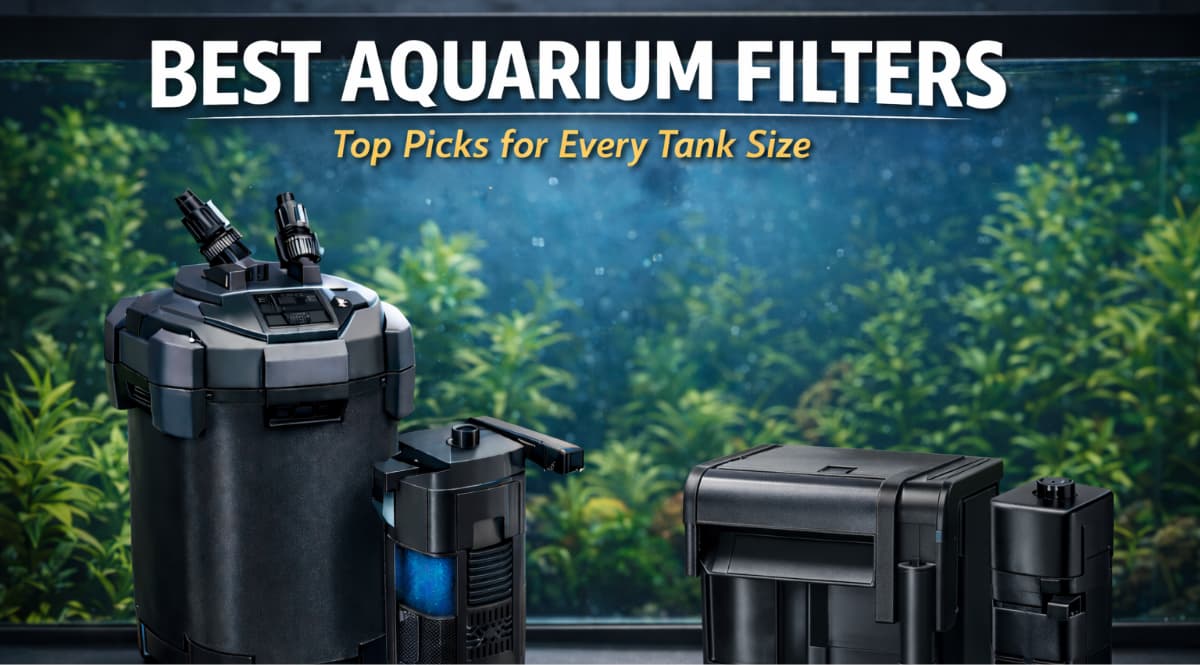
The best aquarium filter depends on your specific needs. Start with your tank size — then match the filter to your fish and your routine. We organized this guide by gallon range (under 10 through 60+ gallons) and selected two filters for each size to cover the most common needs in that category — like gentle filtration for nano tanks, plug-and-play vs media flexibility for community tanks, and HOB vs canister choices for larger aquariums.
Our top picks by tank size:
- Under 10 gallons — Tetra Whisper 4i
- 10-20 gallons — AquaClear 20
- 20-40 gallons — AquaClear 50
- 40-60 gallons — Seachem Tidal 75
- 60+ gallons — Fluval FX2
Best Aquarium Filters for Under 10 Gallons
Small tanks need filters that won’t overpower the fish inside them. Most hang-on-back filters push too much current for tanks this size, so you’re choosing between an internal power filter and a sponge filter. Internal filters are cleaner-looking and require no extra equipment. Sponge filters are cheaper and safer for delicate livestock like shrimp and fry.
Best Internal Filter: Tetra Whisper 4i

Tetra Whisper 4i Internal Power Filter
- Designed for 1-4 gallon aquariums
- 27 GPH flow — cycles a 4-gallon tank 6+ times per hour
- Internal mount lets your tank sit flush against the wall
- Adjustable clip and suction cup positioning
- Uses affordable Small Whisper BioBag cartridges
Why we recommend it: One of the few filters genuinely designed for nano tanks. The internal design saves space, and the gentle 27 GPH flow won't blast small fish around the tank.
The Whisper 4i sits inside the tank on an adjustable clip, keeping the profile compact for desktop and shelf setups. Because there’s nothing hanging off the back, your tank can sit as close as 1 inch from the wall.
The trade-off with any cartridge-based filter is that you’re replacing the entire cartridge each time, including the bacteria growing on it. To preserve your cycle, run the old and new cartridges together for a few days before removing the old one. If you’re setting up a small tank for the first time, our small freshwater tank setup guide walks through the full process.
Good to know: The Whisper 4i works best in tanks 3 gallons or more, where it has room to sit without crowding your layout. For tanks under 3 gallons, consider the sponge filter below.
Best for Shrimp & Breeding Tanks: AQUANEAT Bio Sponge Filter

AQUANEAT Bio Sponge Filter
- Safe for baby shrimp and fry — zero suction risk
- Compact single-sponge design (2" x 4.75") fits tight nano tanks
- Air infusion chamber produces fine bubbles that boost dissolved oxygen
- Minimal current — ideal for bettas, guppies, killifish, and fry
- Easy maintenance — rinse and squeeze the sponge in old tank water
Why we recommend it: If you keep shrimp or breed fish, a sponge filter is the only safe choice. The soft sponge traps debris without any risk of sucking in small livestock, and the gentle air-driven flow won't harm even the smallest fry.
Sponge filters work differently from power filters — they’re driven by an air pump (sold separately) that pushes air through the sponge, drawing water through it. No impeller means no moving parts that can trap small livestock. The AQUANEAT’s compact single-sponge design keeps the footprint small in nano tanks where space matters.
At under $7, the AQUANEAT is the cheapest filter on this list by far. You’ll need a small air pump to run it — any basic aquarium air pump will work.
Good to know: Sponge filters provide strong biological filtration but are weaker at mechanical filtration than power filters — fine particles may stay suspended longer. Pairing with an air pump that has adjustable output lets you dial in the right amount of flow.
Best Aquarium Filters for 10-20 Gallon Tanks
This is the most common tank size range for beginners and community tanks. You want a hang-on-back (HOB) filter that’s easy to set up, quiet enough for a living room, and strong enough to keep the water clear. The split here is between plug-and-play simplicity and long-term media flexibility.
Best for Beginners: Tetra Whisper IQ 20

Tetra Whisper IQ Power Filter 20
- 130 GPH flow rate for tanks up to 20 gallons
- Sound shield technology — under 40 dB operation
- Self-priming submerged motor (no manual priming)
- Stay Clean technology helps maintain stable pH
- Uses large Tetra Whisper Bio-Bag cartridges
Why we recommend it: The easiest filter to set up in this size range. Self-priming means you never siphon or prime — fill the reservoir, plug it in, and it starts. The sound shield keeps it near-silent for bedrooms and living rooms.
The Whisper IQ 20 is the filter you recommend to someone who’s never owned a fish tank. There’s genuinely nothing to figure out — hang it on the rim, fill it with water, plug it in. After power outages, it restarts automatically without intervention.
Tetra rates the Whisper IQ at under 40 dB, making it one of the quietest HOB filters you can buy. Amazon reviewers consistently praise the noise level, with many saying they can’t hear it running from across the room. For tanks in bedrooms or home offices, this matters.
The downside is the proprietary cartridge system. You’re locked into Tetra’s Bio-Bag replacements, and every cartridge swap removes your biological media. It works fine — just budget for monthly cartridge replacements and overlap old and new cartridges for a day when possible.
Good to know: If flow drops over time, cleaning the impeller usually fixes it.
Best for Customization: AquaClear 20

AquaClear 20 Power Filter
- 100 GPH with adjustable flow control
- Open media basket — swap in any media you want
- Included foam, carbon, and BioMax ceramic bio rings
- Reusable foam insert lasts months (just rinse it)
- Filtration volume up to 7x larger than comparable filters
Why we recommend it: The most recommended HOB filter on aquarium forums, and for good reason. The open media basket lets you choose exactly what goes in it — ditch the carbon, double up on bio-media, add Purigen, whatever your tank needs.
The AquaClear 20 is the filter hobbyists graduate to after outgrowing cartridge-based systems. Instead of throwing away a cartridge every month, you rinse the reusable foam insert in old tank water and put it back. The carbon is the only consumable, and many fishkeepers skip it entirely in favor of more biological media.
The adjustable flow dial is the other major advantage. You can throttle it down for tanks with delicate fish or plants that don’t want strong current, or run it wide open for tanks that need maximum circulation.
The one real downside: it doesn’t self-prime. After power outages, you need to manually refill the filter basket to restart it. If you live somewhere with frequent power flickers, that’s worth considering.
Watch out for: No self-priming — must be manually refilled after power outages.
Best Aquarium Filters for 20-40 Gallon Tanks
The 20-40 gallon range is where most freshwater community tanks live — tetras, corydoras, guppies, and planted setups. Filtration needs step up here, and the choice is between dead-simple cartridge filters and HOB filters with open media baskets that give you more control.
Best for Beginners: Marineland Penguin Bio-Wheel

Marineland Penguin Bio-Wheel Power Filter
- Patented rotating Bio-Wheel for wet/dry biological filtration
- Available in 5 sizes: 75, 100, 150, 200, and 350 GPH
- Bacteria survive cartridge changes (Bio-Wheel keeps them alive)
- Affordable Marineland Rite-Size replacement cartridges
- Multi-stage mechanical, chemical, and biological filtration
Why we recommend it: The Bio-Wheel is what makes this filter beginner-proof. When you swap the cartridge, your beneficial bacteria colony stays intact on the spinning wheel. With other cartridge filters, you lose your bacteria every time you change media.
The Marineland Penguin has been a staple in the hobby for years, and the reason is the Bio-Wheel. It’s a rotating wheel at the filter output that stays constantly exposed to both water and air — ideal conditions for nitrifying bacteria. When you pull the old cartridge and drop in a new one, the Bio-Wheel keeps your nitrogen cycle running uninterrupted.
This is a genuine advantage for beginners who might change cartridges too aggressively or too frequently. With a standard cartridge filter, that mistake can crash your cycle. With the Penguin, you’ve got a safety net.
The Penguin comes in five sizes. For a 30-gallon tank, the 150 GPH model provides 5x turnover per hour. For 40 gallons, step up to the 200 GPH model. Both the filter and replacement cartridges are affordable — this is one of the cheapest-to-own filters in the 20-40 gallon range. For biological filter media options to boost the Bio-Wheel’s performance, we have a dedicated guide.
Good to know: If the Bio-Wheel stops spinning, clean the axle bearings in old tank water (never tap water).
Best for Planted Tanks: AquaClear 50
AquaClear 50 Power Filter
- 200 GPH flow with adjustable flow control
- Large open media basket for full customization
- Included foam, carbon, and BioMax bio rings
- Re-filtration system recirculates up to 50% of water at low flow
- Reusable foam insert — no monthly cartridge waste
Why we recommend it: The gold standard HOB filter for planted tanks. The adjustable flow prevents your plants from being blasted, the open media basket lets you run Purigen or extra bio-media instead of carbon, and the reusable foam keeps long-term costs low.
The AquaClear 50 is the 20-50 gallon version of the same design that makes the AquaClear 20 so popular. The open media basket is the key — planted tank owners typically ditch the carbon entirely and fill the space with biological filter media like Seachem Matrix or extra BioMax rings. This gives you far more biological filtration capacity than any cartridge filter in this range.
The adjustable flow is critical for planted tanks. At full power, 200 GPH is strong. Dialed back, the patented re-filtration system recirculates up to 50% of the water through the media chamber before returning it to the tank, giving bacteria more contact time with the water.

Watch out for: No self-priming — you’ll need to refill the basket manually after power outages. The AquaClear 50 costs more upfront than the Marineland, but its reusable foam insert means lower maintenance costs month over month.
Best Aquarium Filters for 40-60 Gallon Tanks
At 40-60 gallons, you’re at the crossroads where a premium HOB filter still works, but a canister filter starts to make real sense. HOBs are simpler to maintain. Canisters are quieter, hold more media, and give you a cleaner look since nothing hangs on the back. We picked one of each.
Best HOB Filter: Seachem Tidal 75

Seachem Tidal 75 Power Filter
- 350 GPH flow with adjustable control
- Self-priming — restarts automatically after power outages
- Built-in surface skimmer removes oil and protein film
- Maintenance indicator tells you when to clean
- Customizable media basket (holds any loose media)
Why we recommend it: The Tidal 75 solves the two biggest complaints about HOB filters: it self-primes after power outages (no more manually filling the basket), and the built-in surface skimmer handles protein film that other HOBs miss entirely.
The Seachem Tidal 75 is what a modern HOB filter should look like. The submerged motor design means it starts automatically every time — no priming, no filling, no intervention after power outages. That alone puts it ahead of the AquaClear for many fishkeepers.
The surface skimmer is the other standout. It has a dual intake that pulls water from both below the waterline and across the surface. Protein film, oil slick, floating debris — the Tidal handles it all. On most HOB filters, you’d need a separate surface skimmer accessory.
The media basket is fully customizable (like the AquaClear), the flow is adjustable from 350 GPH down to about 175 GPH, and the maintenance monitor shows you when things are getting clogged. The 3-year warranty (extendable to 5 with registration) adds confidence.
Watch out for: At $70-80, it’s significantly more expensive than budget HOBs. Not shrimp-safe — baby shrimp can enter through the surface skimmer opening.
Best Canister Filter: Fluval 307

Fluval 307 Performance Canister Filter
- 303 GPH flow rate for tanks 40-70 gallons
- EZ-lift media baskets — pull the entire stack with one hand
- 25% quieter than previous Fluval canister generations
- Includes bio-foam, BioMax, carbon, and pre-filter
- Only 16 watts — extremely energy efficient
Why we recommend it: If you've been running HOB filters and want to try a canister, the 307 is the one to start with. It's sized perfectly for the 40-60 gallon range, the EZ-lift baskets make maintenance much simpler than older canisters, and it runs whisper-quiet.
The Fluval 307 is the entry point into canister filtration for the 40-60 gallon range. The biggest advantage over any HOB is media capacity — the stackable baskets hold far more biological media, which means better water quality and longer intervals between cleanings (4-8 weeks vs. 2-4 for HOBs).
The EZ-lift basket system addresses the main complaint about canisters: maintenance complexity. You pull the center handle and the entire media stack lifts out in one piece. Rinse in old tank water, drop it back in. It’s not quite as fast as swapping an HOB cartridge, but it’s not the ordeal that older canisters were.
Fluval rates the 307 at just 16 watts, making it surprisingly energy efficient. Amazon reviewers confirm the noise reduction over previous Fluval canister generations — multiple describe it as inaudible from a few feet away.

Watch out for: Requires cabinet space below the tank for the canister body. Hose connections need to be properly seated to avoid leaks during initial setup.
Best Aquarium Filters for 60+ Gallon Tanks
At 60 gallons and above, canister filters are the standard. You need serious flow rates, large media capacity, and a filter that can handle the bioload of a heavily stocked tank without frequent maintenance. The choice here is between a versatile all-rounder and maximum convenience.
Best Overall Canister: Fluval FX2

Fluval FX2 High Performance Canister Filter
- 475 GPH flow rate with Smart Pump microchip technology
- 4 media baskets with 1 US gallon total capacity
- Self-priming — fill with water, plug in, done
- Built-in water change drain valve
- 15% smaller than the FX4 — fits under most stands
Why we recommend it: The FX2 brings Fluval's proven FX canister design to a size that fits most 60-125 gallon setups without being overkill. 475 GPH provides strong turnover, the Smart Pump self-maintains, and the built-in drain valve makes water changes on big tanks painless.
The Fluval FX2 is the right starting point for most fishkeepers moving into the 60+ gallon range. At 475 GPH, it provides the turnover needed for 75-gallon community tanks, planted setups, and moderately stocked tanks up to 175 gallons. It’s also 15% smaller than the FX4, which matters when cabinet space is tight.
The Smart Pump technology monitors performance continuously and auto-evacuates trapped air every 12 hours to maintain flow. Self-priming means setup is just filling the canister with water and plugging it in. The built-in drain valve lets you do water changes directly through the filter — a genuine time-saver on large tanks where hauling buckets gets old.
If you have a heavily stocked tank, keep messy fish like cichlids or large goldfish, or have a tank over 125 gallons, step up to the FX4:
For a deeper dive on canister options for big tanks, see our best canister filters guide and best filters for large aquariums.
Watch out for: The canister needs cabinet space beneath the tank. Hose routing takes some planning on initial setup.
Best for Easy Maintenance: OASE BioMaster Thermo 350

OASE BioMaster Thermo 350 Canister Filter
- Built-in 200W heater eliminates a separate in-tank heater
- EasyClean pre-filter pops out without disconnecting the canister
- 5 media trays with large biological filtration capacity
- Self-priming for quick restarts
- German-engineered by OASE (major name in pond filtration)
Why we recommend it: The BioMaster Thermo does something almost no other canister filter does: it combines filtration and heating in one unit. That's one less piece of equipment in your tank and one less failure point to monitor. The pop-out pre-filter also makes routine maintenance dramatically easier.
The OASE BioMaster Thermo 350 takes a different approach than the Fluval FX line. Instead of chasing maximum flow, it focuses on reducing the number of things you need to think about.
The built-in 200W heater is the headline feature. Instead of a separate in-tank heater (which can fail, crack, or be an eyesore), the BioMaster integrates temperature control directly into the canister. For tanks up to 90 gallons, that’s one less piece of equipment cluttering the tank and one less potential failure point.
The EasyClean pre-filter module is the maintenance win. You pop it out with a single clip, rinse the carbon-infused sponges, and snap it back — without disconnecting the canister body or disturbing your biological media. Most routine cleaning takes under a minute.
Watch out for: Rated for up to 90 gallons — if you have a 125+ gallon tank, the FX4 is the better choice. The advertised 300 GPH drops once media is loaded, so plan for lower effective flow in a fully packed canister.
What to Spend: Filter by Budget
Not sure where you land? Here’s what each price tier gets you:
Budget: Under $20
Sponge filters, Whisper 4i, Whisper IQ 20
- Covers tanks from 1-20 gallons
- Simple cartridge or sponge-based filtration
- Great for beginners and nano tanks
- Replacement media is cheap and easy to find
Mid-Range: $25-$80
AquaClear 20/50, Marineland Bio-Wheel, Seachem Tidal
- Covers tanks from 10-75 gallons
- Customizable media and adjustable flow
- Lower long-term cost (reusable foam inserts)
- Best balance of performance and price
Premium: $150+
Fluval 307, FX2/FX4, OASE BioMaster Thermo
- Covers tanks from 40-250+ gallons
- Canister filters with massive media capacity
- Longest maintenance intervals (4-8+ weeks)
- Quietest operation and cleanest aesthetics
Not Sure? Start Here
Match budget to your tank size
- Under 20 gal → Budget tier works great
- 20-40 gal → Mid-range gives best value
- 40-60 gal → Mid-range HOB or entry canister
- 60+ gal → Premium canister is worth it
How to Choose the Right Filter
Three Things That Matter
Match Filter to Tank Size
Choose a filter rated for at least your tank's volume. For heavily stocked tanks (goldfish, cichlids, turtles), go 50-100% above your tank size. A 30-gallon tank with lots of fish should use a filter rated for 45-60 gallons.
Match Flow to Your Fish
Delicate fish like bettas and shrimp need gentle flow — look for adjustable flow or sponge filters. Active swimmers like tetras and barbs handle stronger currents. High-waste fish like goldfish need oversized filtration with strong biological capacity.
Pick Your Maintenance Style
Cartridge filters (Whisper IQ, Marineland Penguin) are the easiest — swap the cartridge and you're done. Open-media HOBs (AquaClear, Tidal) cost less long-term but need periodic media rinsing. Canister filters have the longest intervals but take more effort when you do clean them.
The One Rule That Matters Most
Size up, not down. An oversized filter won’t hurt your fish — the extra flow and media capacity only helps. An undersized filter can crash your cycle and kill your fish. When in doubt, buy the next size up.
Aquarium Filter Types at a Glance
Four types of aquarium filters appear in this guide: internal filters (inside the tank, best under 10 gallons), hang-on-back (HOB) filters (clip on the rim, best 10-60 gallons), canister filters (sit below in the cabinet, best 40+ gallons), and sponge filters (air-pump driven, safest for shrimp and fry). All four provide mechanical, chemical, and biological filtration — with biological filtration (bacteria converting ammonia to nitrate) being the most critical. For a deeper look at bio media, see our best biological filter media guide.
Final Verdict
Under 10 gallons: The Tetra Whisper 4i is the best internal filter for nano tanks. If you keep shrimp or breed fish, the AQUANEAT Bio Sponge Filter is the safer (and cheaper) choice.
10-20 gallons: The Tetra Whisper IQ 20 is the easiest setup for beginners. The AquaClear 20 is better long-term if you want to choose your own media.
20-40 gallons: The Marineland Bio-Wheel is the most beginner-friendly filter with its bacteria-preserving Bio-Wheel. The AquaClear 50 wins for planted tanks and customization.
40-60 gallons: The Seachem Tidal 75 is the best HOB with self-priming and a built-in surface skimmer. The Fluval 307 is the best entry canister — quieter, more media, cleaner look.
60+ gallons: The Fluval FX2 is the best canister for most large tanks — 475 GPH in a compact body that fits under standard stands. For heavy bioloads or 125+ gallon tanks, step up to the FX4. The OASE BioMaster Thermo 350 combines filtration and heating in one unit for the simplest possible setup.
Related guides:
- Canister filter deep-dive: Best canister filters
- Large tank filters: Best filters for large aquariums
- Filter setup: How to set up a fish tank filter
- Too much flow? How to reduce filter flow
- Media changes: How to change your filter without losing bacteria
- Bio media: Best biological filter media
Frequently Asked Questions
What type of aquarium filter is best for beginners?
A hang-on-back (HOB) power filter is the easiest type for beginners. For 10-20 gallon tanks, the Tetra Whisper IQ 20 requires no priming and installs in minutes. For 20-40 gallon tanks, the Marineland Penguin Bio-Wheel is forgiving because its Bio-Wheel preserves beneficial bacteria even when you change cartridges.
How often should I clean my aquarium filter?
Internal and HOB filters need cartridge changes or media rinsing every 2-4 weeks. Canister filters like the Fluval 307 and FX4 can go 4-8 weeks between cleanings due to higher media capacity. Always rinse biological media in old tank water — never tap water — to preserve beneficial bacteria.
What is GPH and why does it matter for aquarium filters?
GPH (gallons per hour) measures how much water a filter processes per hour. Aim for 4-6 complete tank volume cycles per hour. A 20-gallon tank needs 80-120 GPH, a 55-gallon tank needs 220-330 GPH. Higher GPH handles heavier fish loads, while adjustable flow matters for fish that prefer gentle currents like bettas.
Do I need a canister filter or a hang-on-back filter?
HOB filters work well for tanks under 40-50 gallons — they're affordable, easy to maintain, and effective. Canister filters are worth the investment for tanks over 40 gallons, heavily stocked setups, or planted tanks where you want inline CO2. The 40-60 gallon range is where most hobbyists consider making the switch.
How do I choose the right filter size for my aquarium?
Choose a filter rated for at least your tank's volume, and go 50-100% higher for heavily stocked tanks. A 30-gallon tank with lots of fish should have a filter rated for 45-60 gallons. Match flow rate to your fish — bettas and shrimp need gentle flow, while cichlids and goldfish handle stronger currents.
Can I use a sponge filter as my only filter?
Sponge filters work well as the sole filter for tanks under 10 gallons, especially shrimp tanks and breeding setups. For larger tanks, they're better as supplemental filtration. Sponge filters excel at biological filtration but are weaker at mechanical filtration compared to HOB or canister filters.
What are the three main types of aquarium filters?
Internal filters mount inside the tank and work best for nano tanks under 10 gallons. Hang-on-back (HOB) filters clip onto the rim and are the most popular choice for 10-60 gallon tanks. Canister filters sit below the tank in the cabinet and are best for large or heavily stocked tanks over 40 gallons. All three provide mechanical, chemical, and biological filtration.
Found this helpful?
Share this guide with your fellow aquarium enthusiasts!

Written by
FTW Team
The FishTankWorld editorial team brings together experienced aquarists to help you succeed in the hobby.