
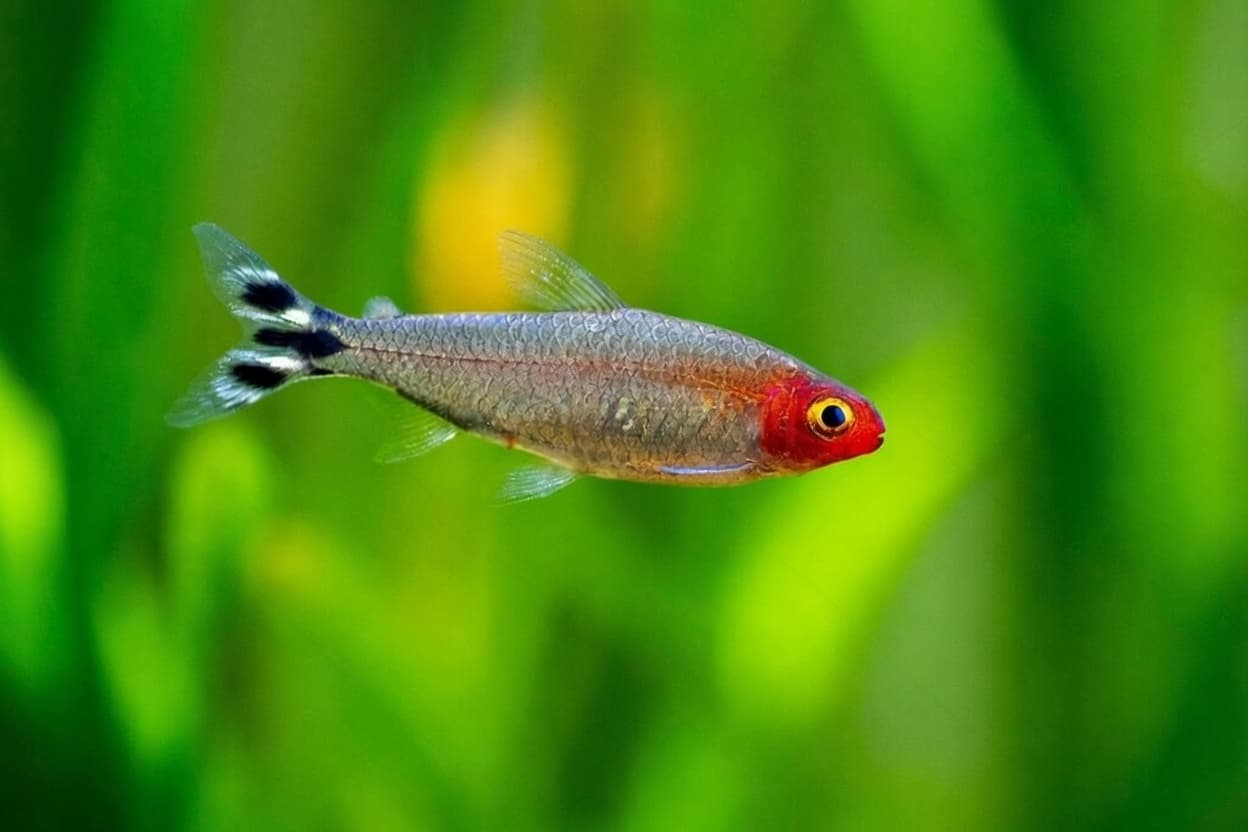
The rummy-nose tetra is one of the most visually striking and behaviorally fascinating freshwater fish available to aquarium hobbyists. Native to the blackwater tributaries of the Amazon basin in South America, these small schooling fish are instantly recognizable by three distinct features: a bright red nose, a sleek silver body, and a boldly striped black-and-white tail.
What sets the rummy-nose tetra apart from other popular tetras is not just its appearance but two standout traits. First, it forms the tightest, most synchronized schools of any commonly available tetra species. A group of rummy-noses moving in unison through a planted tank is genuinely mesmerizing. Second, the intensity of their red nose serves as a real-time indicator of water quality. When conditions deteriorate, the red fades. When everything is right, the red blazes. No other fish gives you such an immediate, visible signal about the health of your aquarium.
This guide covers everything you need to keep rummy-nose tetras healthy: species identification, tank setup, water parameters, diet, schooling behavior, compatible tank mates, and common diseases.
The Aquarium's Canary in the Coal Mine
Rummy-nose tetras are often called the “canary in the coal mine” of the aquarium hobby. Their red nose visibly fades in response to stress, poor water quality, temperature swings, or illness — often before your test kit detects a problem. If you walk by your tank and the red is gone, it is time to test your water immediately.
Rummy-Nose Tetra at a Glance
Care Requirements
The Three Rummy-Nose Species
Three separate species are sold under the name “rummy-nose tetra,” and most hobbyists never realize there is a difference. All three look similar and share the same care requirements, but they differ in the extent of their red coloring and their geographic origins.
Brilliant Rummy-Nose (Hemigrammus bleheri)
This is the species you are most likely to find at your local fish store. The brilliant rummy-nose has the most intense red coloring of the three, extending well past the gill plate and sometimes reaching the base of the pectoral fins. It originates from the Rio Negro in Brazil and the Rio Vaupes in Colombia — deep blackwater tributaries of the Amazon. Its superior coloration has made it the dominant species in the aquarium trade.
True Rummy-Nose (Hemigrammus rhodostomus)
The original species described under the rummy-nose name. The red coloring on the true rummy-nose is confined to the snout and does not extend past the gill cover. It comes from the lower Amazon basin in Brazil’s Para state. This species is rarely seen in the hobby today because the brilliant rummy-nose has largely replaced it in commercial breeding.
False Rummy-Nose (Petitella georgiae)
The false rummy-nose is distinguished by the central black stripe on its tail extending forward onto the body — a feature absent in the other two species. It is found in the western Amazon in both Brazil and Peru. The red coloring is less intense than in H. bleheri. This species appears in the trade occasionally, sometimes mixed in with shipments of H. bleheri.
Don't Worry About Species Identification
All three rummy-nose species have identical care requirements. Unless you are specifically trying to breed them, it does not matter which species you have. Most fish stores sell Hemigrammus bleheri, and many sellers simply label them “rummy-nose tetra” without distinguishing the species.
The Water Quality Indicator
The most remarkable feature of rummy-nose tetras is their red nose functioning as a living water quality gauge. The red pigment on their head responds directly to their physiological state. When the fish is healthy, unstressed, and in good water conditions, the red is vivid and intense. When something is wrong, the red fades to pink or disappears entirely, leaving a pale, washed-out face.
This response is triggered by:
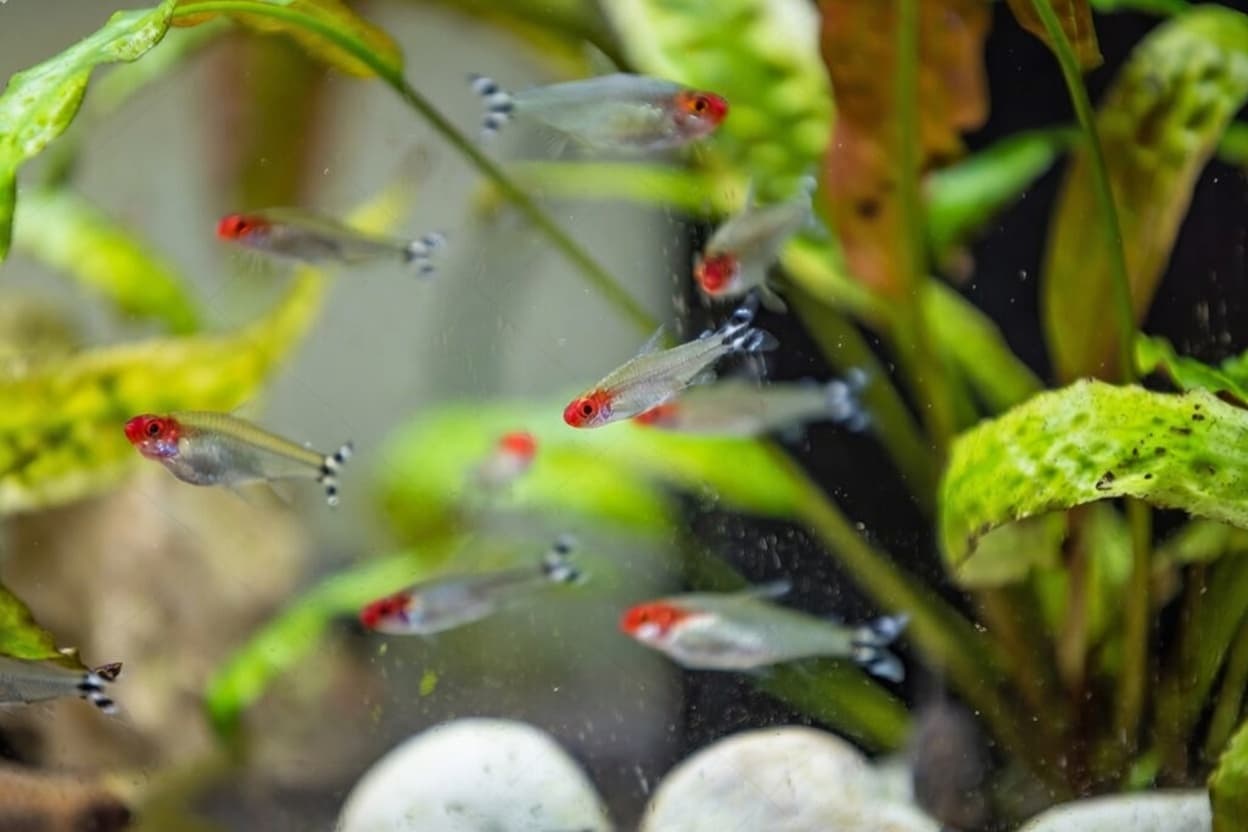
Vivid red noses mean healthy fish and clean water — a faded nose is the first sign something is wrong.
What Causes the Red to Fade
- Ammonia or nitrite above zero — even small spikes cause visible fading
- High nitrate levels (above 20 ppm)
- Temperature outside their preferred range or sudden temperature swings
- pH fluctuations or extremes
- Stress from aggressive tank mates, overcrowding, or too-small groups
- Recent transport — newly purchased fish often arrive with pale noses
- Illness or parasitic infection
There is one completely normal exception: rummy-nose tetras lose their red coloring at night while resting. They become almost entirely silver in the dark. The red returns within minutes of the lights coming back on. If the color does not return during the day, investigate water quality.
This indicator trait makes rummy-nose tetras uniquely useful in community tanks. A quick glance at their noses tells you whether the tank environment is stable. Many experienced fishkeepers add a school of rummy-noses specifically for this purpose, particularly in tanks housing sensitive species.
Tank Requirements
Rummy-nose tetras are active swimmers that cover the full length of the aquarium. A minimum tank size of 20 gallons is required for a school, and a longer tank (36 inches or more) is strongly preferred over a tall one. These fish swim horizontally in tight formation and need the space to do it.
Substrate and Decor
In the wild, rummy-nose tetras live in tannin-stained blackwater over soft sandy riverbeds with decomposing leaf litter, driftwood, and some aquatic vegetation.
You don’t need to replicate the Amazon, but your substrate choice can affect their comfort and color:
- River sand or fine sand — closest to their natural environment. Smooth, easy to clean, and pairs well with driftwood and leaf litter for a blackwater-style setup.
- Black sand — provides strong color contrast against their silver bodies and red noses. A popular choice if you’re not going full biotope.
- Planted tank soil (Fluval Stratum, ADA Amazonia) — works well if you’re running a planted setup. Naturally softens water and lowers pH, which rummy-noses prefer. See our best substrate for planted tanks for a full comparison.
What sits on top of the substrate matters just as much. Driftwood, dried catappa leaves, and botanicals like alder cones release tannins that tint the water, lower pH, and create the conditions these fish evolved in.
Plants and Swimming Space
Rummy-nose tetras prefer darker water and inhabit the middle to mid-lower water column. The key to a good setup is balancing cover with open swimming space. Plant the back and sides of the aquarium heavily, but leave a large open area in the center and front for the school to move through. Good plant choices include Java fern, Amazon sword, Vallisneria, and Anubias. Floating plants are particularly beneficial — they dim the lighting and replicate the shaded conditions these fish naturally seek out. For a full planted setup, see our low-tech planted aquarium guide.
Ideal Tank Setup
- 20-gallon minimum, with a preference for 30 gallons or larger for bigger schools
- Long tanks (36 inches or more) rather than tall tanks for horizontal swimming space
- Dark substrate to enhance coloration
- Heavy planting along back and sides with open swimming space in the center
- Floating plants to diffuse lighting and reduce stress
- Driftwood, catappa leaves, and botanicals for a natural blackwater environment
- Moderate water flow — they enjoy gentle current but not strong powerheads
- A tight-fitting lid, as rummy-nose tetras are capable jumpers
Filtration and Flow
Moderate filtration with gentle to moderate flow suits rummy-nose tetras well. They come from rivers and enjoy some current, but they are not strong enough swimmers to handle powerful flow rates. A hang-on-back filter or canister filter with an adjustable output works well. Sponge filters are also effective, especially in smaller setups. The filter should turn over the tank volume 4 to 6 times per hour while keeping flow gentle enough that the fish can swim comfortably in all areas of the tank.
Water Requirements
This is where rummy-nose tetras demand more attention than beginner-friendly species like neon tetras. They are more sensitive to water quality fluctuations and require softer, more acidic water than many other common community fish.
Fully Cycled Tanks Only
Never add rummy-nose tetras to an uncycled or newly cycled tank. These fish are extremely sensitive to ammonia and nitrite. Your aquarium should be fully cycled and mature with stable parameters for at least 6 to 8 weeks before introducing rummy-nose tetras. A mature tank with established biological filtration is critical.
Temperature
Rummy-nose tetras do well in 74 to 79°F (23 to 26°C). A target of 75 to 78°F works well for most setups.
pH and Hardness
They prefer slightly acidic to neutral water with a pH of 5.5 to 7.0 and soft water with a general hardness (GH) of 2 to 8 dGH. While they can adapt to slightly harder water if conditions are stable, they show their best coloration and behavior in soft, acidic conditions. If you have very hard or alkaline tap water, rummy-nose tetras may not be the right choice unless you are prepared to use RO water or a remineralizing system.
Water Change Schedule
Consistent water changes are non-negotiable. Perform 20% water changes weekly at minimum. Rummy-nose tetras do not tolerate elevated nitrates — keep levels below 20 ppm. Always match the temperature and pH of new water to the tank water before adding it. A temperature difference of more than 2°F during a water change can stress these fish enough to trigger visible nose fading.
What to Feed
Rummy-nose tetras are omnivores with straightforward dietary needs. In the wild, they feed on small insects, insect larvae, tiny crustaceans, and plant debris. A varied diet in captivity keeps them healthy and supports vivid coloration.
Recommended Diet
- High-quality micro pellets or crushed flake food as the daily staple
- Frozen or freeze-dried brine shrimp 2 to 3 times per week
- Frozen or freeze-dried daphnia for variety and digestive health
- Frozen bloodworms as an occasional treat (once or twice a week)
- Micro worms or baby brine shrimp as a high-protein supplement
Feed small amounts twice per day that the fish can consume within 1 to 2 minutes. Rummy-nose tetras have small stomachs and overfeeding leads to uneaten food decomposing on the bottom, which degrades the water quality they are so sensitive to. If food is reaching the substrate uneaten, reduce the amount.
Why They School Tighter Than Any Other Tetra
This is where rummy-nose tetras truly distinguish themselves. Among commonly available aquarium fish, they form the tightest, most coordinated schools. While many tetra species loosely shoal — swimming in the same general area without much coordination — rummy-nose tetras move in genuine synchronized formation, changing direction as a unit like a flock of birds.
Group Size
A minimum of 8 to 10 individuals is required to see proper schooling behavior. In groups smaller than 8, the fish tend to scatter and act nervously rather than forming a cohesive school. In groups of 15 to 20 or more, the schooling becomes genuinely spectacular. The fish move through the tank in tight formation, pivot together, and create the kind of living display that draws people into the fishkeeping hobby.
Go Big on School Size
If your tank allows it, aim for 15 to 20 rummy-nose tetras or more. The difference in behavior between a school of 6 and a school of 20 is dramatic. In smaller groups, they tend to hover and scatter. In larger groups, they exhibit the synchronized, coordinated movement that makes this species famous. A school of 20 rummy-noses in a planted 55-gallon tank is beautiful to watch.
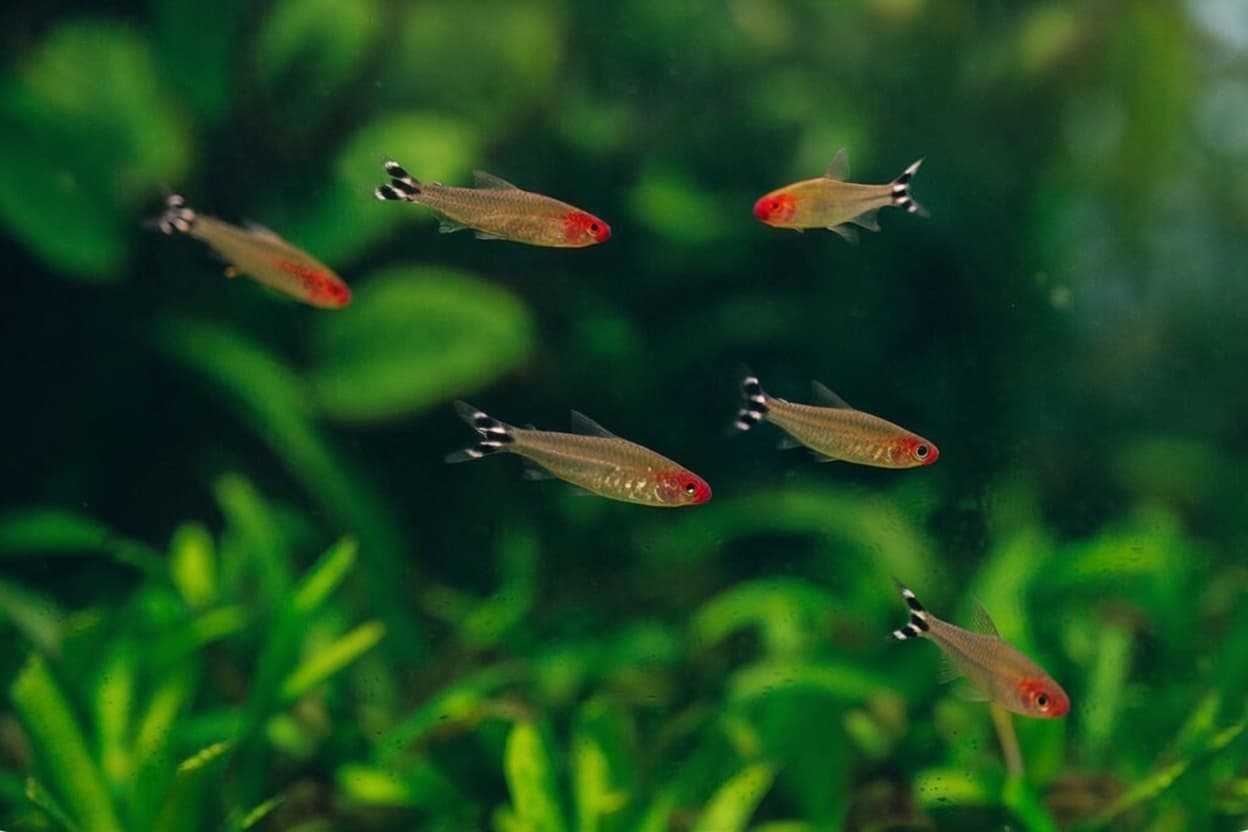
Rummy-nose tetras form the tightest schools of any commonly available tetra — groups of 15 or more produce the best synchronized movement.
Why They School So Tightly
In the wild, tight schooling is a defense against predators. A synchronized group makes it extremely difficult for a predator to single out one fish. This instinct is deeply hardwired — even in a predator-free aquarium, rummy-nose tetras maintain this behavior if the group is large enough. The presence of larger fish in the tank (even peaceful ones) often intensifies schooling behavior as the tetras instinctively tighten their formation.
Community Tank Mates
Rummy-nose tetras are peaceful fish that work well in community tanks with species that share their preference for soft, slightly acidic water. The main considerations are temperature compatibility, temperament, and size.
Compatible Species
Good Tank Mates
- Cardinal tetras — similar water preferences and peaceful temperament
- Other small tetras (ember tetras, neon tetras) — peaceful schoolers in the same temperature range
- Corydoras catfish — peaceful bottom-dwellers that share their preference for soft water
- Otocinclus catfish — gentle algae eaters that stay out of the way
- Harlequin rasboras — peaceful mid-water schoolers with compatible needs
- Kuhli loaches — nocturnal bottom-dwellers that occupy a different zone
- Cherry shrimp and Amano shrimp — peaceful invertebrates that add bottom-level activity
- Nerite snails — completely peaceful and useful algae cleaners
Corydoras are a natural pairing — they fill the bottom of the tank while rummy-noses occupy the mid-water. For a tetra-focused community, pairing rummy-noses with cardinal tetras or neon tetras covers the mid-water with contrasting colors and schooling patterns.
Species to Avoid
Incompatible Tank Mates
- Large or aggressive cichlids (oscars, Jack Dempseys, green terrors) — will eat them
- Tiger barbs and other fin-nipping barbs — cause chronic stress
- Goldfish — require cooler water and will eat small tetras as they grow
- Chinese algae eaters — become territorial and aggressive with age
- Red-tail sharks and rainbow sharks — territorial and intimidating to schooling fish
Health and Disease
Rummy-nose tetras are more susceptible to health problems than hardier species because of their sensitivity to water quality. Most diseases in rummy-noses trace directly back to poor water conditions or stress.
Ich (White Spot Disease)
Ich is the most common disease affecting rummy-nose tetras, presenting as small white dots resembling grains of salt on the body and fins. It is typically triggered by temperature drops or stress. Treatment involves gradually raising the water temperature to 86°F over 48 hours combined with an ich medication containing malachite green. The elevated temperature speeds up the ich parasite’s life cycle, making medication more effective. This is a short-term therapeutic measure — return the temperature to the normal 74-79°F range once treatment is complete. Remove activated carbon from the filter during treatment.
Columnaris
Columnaris is a bacterial infection that appears as white, cottony patches on the mouth, body, or fins. It can progress rapidly and is often fatal if untreated. Rummy-nose tetras are susceptible when stressed or in degraded water. Treatment with kanamycin or nitrofurazone should begin immediately if symptoms appear.
Neon Tetra Disease
Despite its name, neon tetra disease affects many tetra species including rummy-nose tetras. It is caused by the parasite Pleistophora hyphessobryconis and presents as color fading, difficulty swimming, and a curved spine. There is no cure. Infected fish should be removed immediately to prevent transmission.
Disease Prevention
- Maintain pristine water quality — the single most important factor
- Quarantine all new fish for 2 to 3 weeks before adding them to the main tank
- Buy from reputable sources that quarantine their own stock
- Avoid purchasing fish with pale noses unless they just arrived at the store
- Keep nitrates below 20 ppm with consistent weekly water changes
- Maintain stable temperature — avoid fluctuations of more than 2°F
Acclimation Matters
Rummy-nose tetras do not handle transport well. New arrivals often have pale noses and may be lethargic for the first few days. Drip acclimate them over 45 to 60 minutes to avoid shocking them with different water chemistry. Expect it to take 1 to 2 weeks for newly purchased rummy-nose tetras to settle in and display full coloration.
Sources
- FishBase — Hemigrammus bleheri
- SeriouslyFish — Hemigrammus bleheri
- FishBase — Hemigrammus rhodostomus
- Küchler, Miekeley & Forsberg (2000) — “A contribution to the chemical characterization of rivers in the Rio Negro Basin, Brazil.” Journal of the Brazilian Chemical Society, 11(3), 286-292.
Frequently Asked Questions
How many rummy-nose tetras should I keep together?
A minimum of 8 to 10 rummy-nose tetras is recommended, though groups of 15 to 20 or more produce the most impressive schooling behavior. Rummy-nose tetras form tighter schools than almost any other commonly available tetra, and this behavior only fully develops in larger groups. A school of 6 is the absolute minimum, but the fish will be noticeably less active and less colorful.
Why is my rummy-nose tetra's nose turning pale?
A pale or faded nose is a direct indicator of stress or poor water quality. Test your ammonia, nitrite, nitrate, and pH immediately. Common causes include ammonia or nitrite above zero, high nitrates, temperature swings, recent transport, or illness. Rummy-nose tetras also lose their red coloring at night while sleeping, which is completely normal. If the red returns when lights come on, there is no issue.
Are rummy-nose tetras good for beginners?
Rummy-nose tetras are best suited for intermediate fishkeepers. They are more sensitive to water quality than neon tetras and require a fully cycled, mature tank with stable parameters. They do not tolerate ammonia, nitrite, or parameter fluctuations well. If you are new to the hobby, start with hardier species and consider rummy-nose tetras once you have experience maintaining consistent water quality.
Can rummy-nose tetras live with discus?
Many hobbyists keep them together, but it's a temperature compromise. Discus need 82 to 86 degrees Fahrenheit, while rummy-nose tetras are most comfortable at 74 to 79 degrees. Rummy-noses can tolerate the low 80s, which is why the pairing exists, but they're at the upper end of their comfort zone. If your priority is ideal conditions for the rummy-noses, a tank in the mid to upper 70s with species that share that range is a better fit.
What is the difference between the three rummy-nose tetra species?
The three species are the true rummy-nose (Hemigrammus rhodostomus), the brilliant rummy-nose (Hemigrammus bleheri), and the false rummy-nose (Petitella georgiae). The brilliant rummy-nose (bleheri) has the most intense red coloring that extends past the gill plate, and is the species most commonly sold in fish stores. The true rummy-nose has red confined to the snout area, while the false rummy-nose has a black caudal stripe that extends onto the body.
Do rummy-nose tetras jump?
Yes. Rummy-nose tetras are capable jumpers and will leap out of open-top tanks, especially when startled or stressed. A tight-fitting lid or cover is essential. Floating plants can also help by reducing the open surface area and making the fish feel more secure, which decreases jumping behavior.
How long do rummy-nose tetras live?
Rummy-nose tetras live 5 to 6 years on average in well-maintained aquariums. With excellent water quality, a varied diet, and low stress, some specimens can reach 8 years. Lifespan is heavily influenced by water conditions because these fish are more sensitive to parameter issues than many other tetra species.
Can rummy-nose tetras live with neon tetras?
Yes. Rummy-nose tetras and neon tetras share a similar temperature range (74 to 79 degrees for rummy-noses, 73 to 82 degrees for neons) and both prefer soft, slightly acidic water. A temperature of 75 to 78 degrees works well for both species. Both are peaceful mid-water schoolers, so a 30-gallon or larger tank gives both schools adequate swimming space.
Found this helpful?
Share this guide with your fellow aquarium enthusiasts!

Written by
Jonathan Jenkins
I've been keeping fish for over 15 years — everything from planted freshwater tanks to saltwater reefs. I currently have a 30 gallon overstocked guppy breeding tank, 40 gallon planted self-cleaning aquarium, 200 gallon reef tank, and 55 gallon frag tank. I joined Fish Tank World to continue learning while sharing what I've learned along the way.