
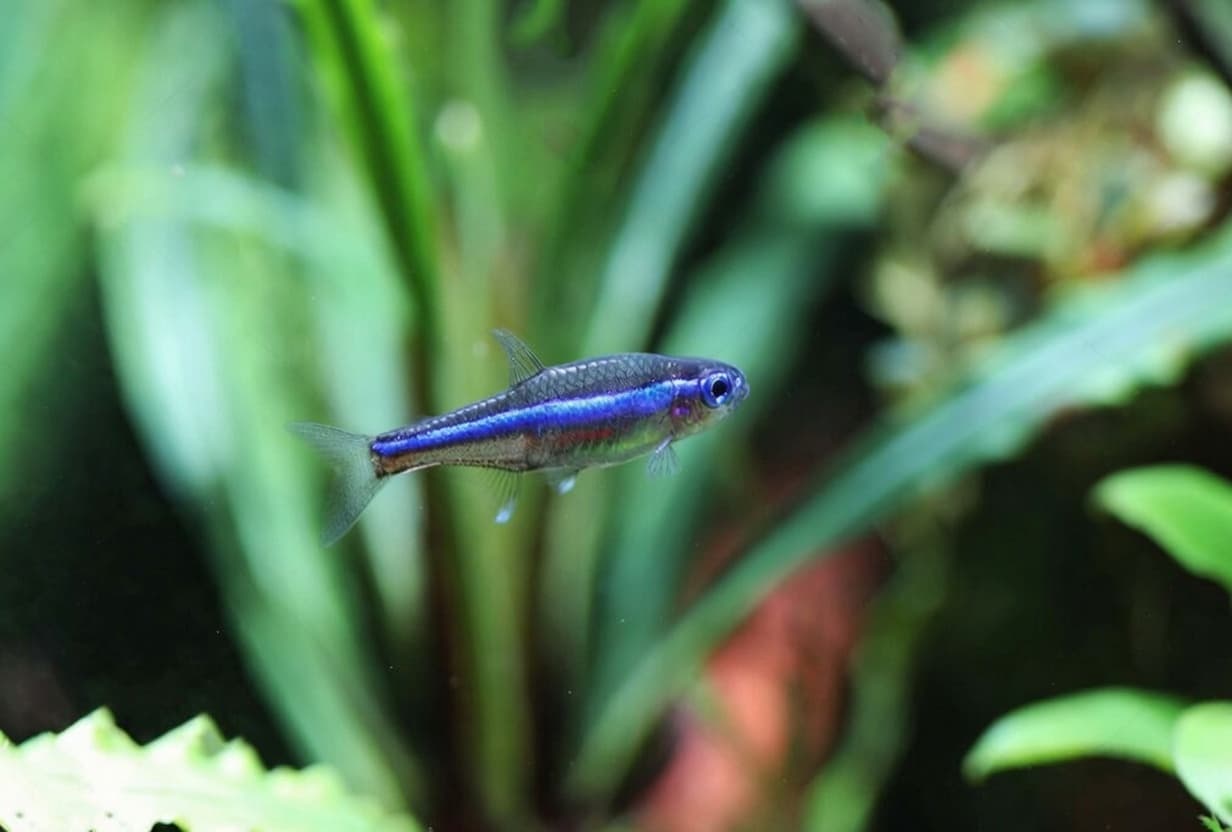
The green neon tetra (Paracheirodon simulans) is the smallest and least well-known member of the Paracheirodon genus — a trio that includes the wildly popular neon tetra (P. innesi) and cardinal tetra (P. axelrodi). At just 1 inch fully grown, the green neon tetra is a true nano fish, and its brilliant blue-green iridescent stripe — which extends the full length of the body — glows against dark water and green plants in a way that photographs struggle to capture.
Green neon tetras are native to the blackwater tributaries of the upper Rio Negro and Orinoco river basins in South America. Unlike neon tetras, which have been captive-bred in enormous numbers for decades, green neon tetras are mostly wild-caught. This gives them a natural robustness that mass-bred neons often lack, but it also means they are more particular about water chemistry — soft, acidic water brings out their best.
This guide covers everything you need to keep green neon tetras healthy and displaying their most vivid coloration: tank setup, blackwater parameters, diet for their tiny mouths, schooling requirements, compatible tank mates, and how they compare to their more famous relatives.
Green Neon Tetra at a Glance
Green Neon Tetra
Paracheirodon simulans
| Parameter | Value |
|---|---|
| Tank Size | 10+ gallons |
| Temperature | 74-82°F (23-28°C) |
| pH Range | 5.0-7.0 |
| Lifespan | 3-5 years |
| Adult Size | 1 inch (2.5 cm) |
| Diet | Omnivore / Micropredator |
| Difficulty | Beginner-Intermediate |
How Green Neons Differ From Neon and Cardinal Tetras
The three Paracheirodon species each fill a different niche. Understanding the differences helps you pick the right one for your setup.
Green neon tetras are the smallest at 1 inch, have the most prominent blue-green iridescent stripe (extending the full length of the body to the tail), and show minimal red — just a faint reddish patch near the tail. They prefer the softest, most acidic water of the three and look their best in blackwater setups.
Neon tetras are mid-sized at 1.5 inches, display a distinct blue stripe with a vivid red band covering the back half of the body. Decades of captive breeding have made them the most adaptable of the three, tolerating a wide range of water conditions.
Cardinal tetras are the largest at up to 2 inches, with a full-body red stripe from eye to tail that creates the boldest display. Most are wild-caught and prefer warm, soft water.
For a deeper dive into the neon vs cardinal comparison, see our cardinal tetra vs neon tetra guide.
The Blackwater Paracheirodon
Of the three Paracheirodon species, green neon tetras are the most closely tied to blackwater conditions. While neon and cardinal tetras adapt reasonably well to neutral, moderately hard water, green neon tetras display their best coloration and most natural behavior in soft, acidic water with tannin staining. If you are building a blackwater nano tank, green neons are the ideal Paracheirodon choice.
Aquarium Setup
Green neon tetras thrive in planted nano tanks with soft, acidic water and subdued lighting. A 10-gallon tank is the recommended minimum for a school of 8 to 10 fish. If you want a larger school of 15 to 20 — which produces the most impressive display — a 20-gallon tank gives them room to school naturally without overcrowding.
Substrate
Dark substrates bring out the strongest coloration in green neon tetras. On light-colored gravel, they look pale and unremarkable. On dark substrate in tannin-stained water, the blue-green stripe appears to glow.
- Planted tank soil (Fluval Stratum, ADA Amazonia) — the best choice for green neon setups. Naturally lowers pH and softens water, which green neons prefer. Ideal if running a planted tank.
- Black sand — provides strong color contrast and works well for shrimp-safe setups with cherry shrimp.
- Fine dark gravel — a simpler option for setups without live plants.
Plants and Decor
Green neon tetras feel most secure in densely planted tanks with plenty of cover. Fine-leaved plants like Java moss, Cabomba, and Pogostemon stellatus create the kind of dense vegetation these fish naturally inhabit. Driftwood and Indian almond leaves add tannins that tint the water, lower pH, and create the blackwater aesthetic that brings out their best color.
Ideal Tank Setup
- Dark substrate to maximize iridescent color contrast
- Dense clusters of fine-leaved plants with open swimming areas in between
- Floating plants (Salvinia, Red Root Floaters, Amazon Frogbit) to dim overhead lighting
- Driftwood and Indian almond leaves for tannins and a natural blackwater look
- Gentle filtration — a sponge filter is ideal for fish this small
- A secure lid — green neon tetras can jump when startled
Lighting
Green neon tetras come from heavily shaded blackwater streams and prefer subdued lighting. Bright overhead lights stress them and wash out their coloration. Floating plants are the simplest way to create the diffused, dappled lighting these fish thrive in. Under moderate lighting against dark water, their blue-green stripe has a vivid, electric quality that bright lights cannot produce.
Filtration
Green neon tetras need gentle flow. At just 1 inch, they are easily pushed around by strong currents. A sponge filter is the ideal choice — it provides gentle biological filtration with minimal current and eliminates the risk of tiny fish being pulled into filter intakes.
If you use a hang-on-back or canister filter, cover the intake with a pre-filter sponge. This is not optional with fish this small. Adjust the flow rate to the lowest comfortable setting.
Water Parameters
Water chemistry is where green neon tetra care becomes more specific than many common community fish. Green neon tetras originate from some of the softest, most acidic freshwater on earth — the blackwater tributaries of the upper Rio Negro, where pH can drop below 5.0 and hardness is near zero.
Temperature
Aim for 75-80°F (24-27°C). The full tolerance range is 74 to 82°F (23 to 28°C).
- 74-75°F — Lower end. Tolerated but not ideal for long-term color and activity.
- 75-80°F — Comfortable range where green neon tetras display their best coloration.
- 80-82°F — Upper end. Increases metabolism and may shorten lifespan over extended periods.
An adjustable heater is essential for maintaining stable temperatures, even in warm climates where nighttime drops can occur.
pH and Hardness
Target pH 5.0-7.0 and hardness under 8 dGH. Green neon tetras are more particular about water softness than neon or cardinal tetras.
- pH 5.0-6.0 — Closest to their natural habitat. Wild-caught green neons display their most vivid coloration in this range.
- pH 6.0-7.0 — Well-tolerated, especially by fish that have spent time acclimating in a dealer’s tanks.
- Hardness 1-8 dGH — Soft water is strongly preferred. Avoid hard water above 10 dGH.
Soft Water Matters
Green neon tetras are less forgiving of hard, alkaline water than regular neon tetras. If your tap water is hard (above 10 dGH) or alkaline (pH above 7.5), neon tetras or ember tetras are easier choices that will thrive without adjusting your water chemistry.
Water Quality
Keep ammonia and nitrite at 0 ppm at all times and nitrate below 20 ppm. Green neon tetras are sensitive to dissolved waste, and poor water quality causes rapid color fading and increased disease susceptibility.
Perform 20% water changes weekly. In smaller tanks under 15 gallons, consider twice-weekly water changes since parameters shift faster in low-volume setups. Always match the temperature of replacement water to the tank — even a 2 to 3°F difference can stress fish this small.
Diet
Green neon tetras are omnivores with tiny mouths. In the wild, they feed on small invertebrates, zooplankton, and plant matter. Their size means food needs to be small enough for them to eat comfortably — large pellets and unground flakes will just be ignored.
What to Feed
Recommended Diet
- Crushed flake food or micro pellets as a daily staple
- Baby brine shrimp (live or frozen) — an excellent protein source they readily accept
- Daphnia and cyclops (live or frozen) — great for digestion and color enhancement
- Microworms and vinegar eels for easy-to-eat live food variety
- Finely chopped frozen bloodworms as an occasional treat
- Spirulina flakes or crushed algae wafers for plant-based nutrition
How Often to Feed
Feed green neon tetras once or twice per day in small amounts they finish within 60 to 90 seconds. Their stomachs are tiny, and overfeeding is one of the most common mistakes with nano fish. Uneaten food decomposes quickly in small tanks and spikes ammonia — exactly the kind of water quality problem these sensitive fish cannot tolerate.
Color Through Diet
A varied diet that includes live or frozen foods like baby brine shrimp and daphnia is one of the most effective ways to bring out the blue-green iridescence in green neon tetras. These foods contain natural pigments that the fish metabolize into more vivid coloration over time. A dry-food-only diet produces noticeably duller fish.
Schooling Behavior
Green neon tetras are a shoaling species that naturally gather in large groups in the blackwater streams of the upper Rio Negro. They are shy, small fish that rely on group numbers for security — and they show it.
School Size
Keep a minimum of 8 to 10 green neon tetras, though groups of 12 to 20 produce dramatically better results. In smaller groups, green neon tetras hide constantly, stay pale, and rarely venture into the open. In groups of 15 or more, they form flowing, tight schools that move through the planted areas of the tank with visible confidence.
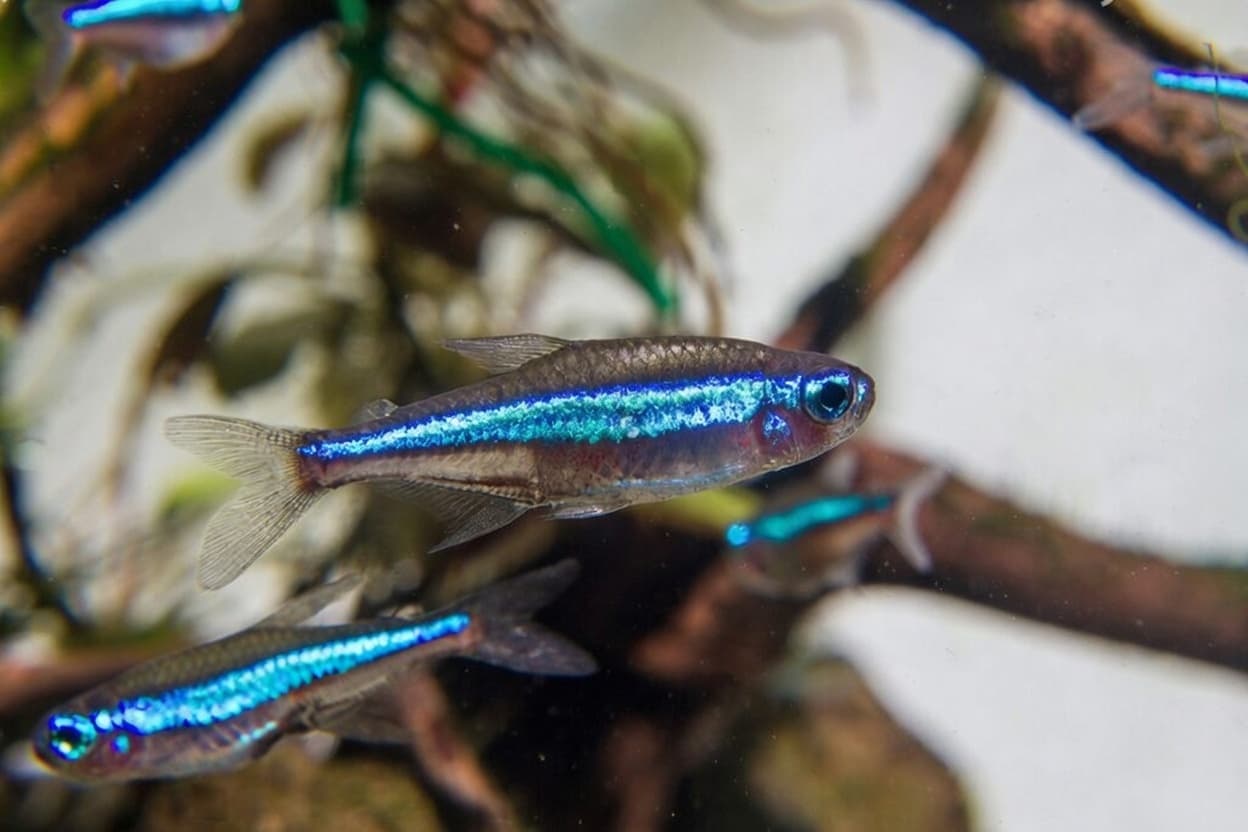
Green neon tetras school tighter and display stronger color in groups of 12 or more — larger schools are always worth the investment.
Green neon tetras school more tightly than regular neon tetras and more loosely than rummy-nose tetras. Their schooling behavior intensifies when they feel any perceived threat — a larger fish swimming nearby, movement outside the tank, or a water change — and relaxes during calm periods into a loose, drifting cluster.
Temperament
Green neon tetras are extremely peaceful. They show no aggression toward tank mates and are not fin nippers. They occupy the mid-water column, spending most of their time swimming between the substrate and the surface. Males may occasionally display to each other with brief, harmless fin-flaring, but these interactions are subtle and short-lived.
Compatible Tank Mates
Green neon tetras are excellent community fish for nano and small tank setups, but their tiny size limits which species they can safely live with. Any fish large enough to fit a green neon tetra in its mouth is a potential predator.
Good Tank Mates
Compatible Species
- Cherry shrimp — one of the best pairings, green neon mouths are too small to eat adult shrimp
- Ember tetras — similar size, temperament, and complementary orange coloration
- Pygmy corydoras (C. pygmaeus, C. habrosus) — tiny peaceful bottom-dwellers
- Otocinclus catfish — gentle algae eaters that ignore other fish
- Chili rasboras and other micro rasboras — similar size and peaceful nature
- Kuhli loaches — nocturnal bottom-dwellers that coexist without conflict
- Honey gouramis — calm centerpiece fish that pose no threat
- Nerite snails and mystery snails — peaceful tank cleaners
Green neon tetras pair particularly well with cherry shrimp. At 1 inch, their mouths are physically too small to eat adult cherry shrimp, making them one of the safest fish choices for a shrimp tank. Dense plant cover provides enough shelter for shrimplets to survive and grow. Many shrimp keepers specifically choose green neon tetras as their tank fish for this reason.
Species to Avoid
Incompatible Tank Mates
- Angelfish — will eat green neon tetras once they reach adult size
- Cichlids of any size — too aggressive and predatory for fish this small
- Tiger barbs and serpae tetras — aggressive fin nippers that will harass them
- Goldfish — need cooler, harder water and will eat small fish as they grow
- Large tetras like Congo tetras in small tanks — their active swimming can intimidate green neons
- Any fish with a mouth large enough to swallow a 1-inch fish
Size Matters
Green neon tetras are among the smallest commonly kept aquarium fish at just 1 inch. Many popular community fish — including adult angelfish, larger gouramis, and even full-grown standard neon tetras in some cases — can be too large or boisterous as tank mates in small setups. Match green neons with similarly sized, peaceful species for the best results.
Why Are My Green Neon Tetras Pale?
If it happens when the lights first come on, it’s normal. Green neon tetras fade their coloration while resting. Full color returns within minutes.
If the blue-green stripe stays dull during the day:
- Water too hard or alkaline — Green neon tetras display their best color in soft, acidic water (pH 5.0-6.5, under 8 dGH). In hard, alkaline water, they often look permanently washed out.
- No tannins — Adding Indian almond leaves, alder cones, or blackwater extract darkens the water and dramatically enhances their iridescence.
- School too small — Fish in groups under 8 are chronically stressed and fade as a result.
- Substrate too light — Light-colored gravel or bare-bottom tanks cause fish to pale. Dark substrates trigger natural pigment intensification.
- Diet — A dry-food-only diet dulls coloration. Add frozen baby brine shrimp and daphnia for carotenoid pigments.
- Lighting too bright — Harsh overhead light washes out iridescent coloration. Add floating plants.
The best-looking green neon tetra tanks combine dark substrate, tannin-stained water, floating plants, and a school of 12 or more. Get those four things right, and the blue-green stripe will glow.
Common Health Issues
Green neon tetras are hardy fish once established in a suitable environment. Their wild-caught origins give them stronger immune systems than mass-bred species, but they are still susceptible to common aquarium diseases — especially during the stress of acclimation and in poor water quality.
Ich (White Spot Disease)
Ich presents as small white dots on the body and fins. Green neon tetras are susceptible to ich after temperature swings or transport stress. Treatment involves gradually raising the water temperature to 82°F over 48 hours while using an ich medication. Reduce medication dosage by 25 to 50% compared to the standard recommendation, as fish this small can be sensitive to full-strength treatments. Remove activated carbon from the filter during treatment.
Fin Rot
Fin rot appears as frayed or receding fin edges and is almost always caused by poor water quality. Improving tank maintenance with more frequent water changes typically resolves mild cases. For persistent fin rot, treat with a broad-spectrum antibacterial at reduced dosage.
Acclimation Stress
Because most green neon tetras are wild-caught, they arrive at fish stores after transport from South America. Newly purchased fish may be pale, shy, and lethargic for the first few days. Drip acclimate them over 1 to 2 hours to gradually adjust them to your water chemistry. Dim the lights for the first 24 to 48 hours and avoid feeding for the first 12 hours. Most green neon tetras settle in and begin displaying full color within 1 to 2 weeks.
Quarantine New Fish
Always quarantine new green neon tetras in a separate tank for 2 to 3 weeks before adding them to your display aquarium. A simple 5-gallon tank with a sponge filter, dim lighting, and some Indian almond leaves works well. This gives you time to observe for disease and allows the fish to recover from transport stress before entering the main tank.
Sources
- FishBase — Paracheirodon simulans species profile. Temperature, pH, size, and distribution data.
- SeriouslyFish — Paracheirodon simulans care profile. Tank size, diet, behavior, and breeding notes.
- Wikipedia — Green neon tetra. Taxonomic classification and habitat overview.
Frequently Asked Questions
What is the difference between green neon tetras and regular neon tetras?
Green neon tetras are smaller (1 inch vs 1.5 inches), have a more prominent blue-green iridescent stripe that extends the full length of the body to the tail, and show minimal red coloration compared to the vivid red stripe on neon tetras. Green neons also prefer softer, more acidic water and are mostly wild-caught, which makes them hardier but less tolerant of hard or alkaline water. Neon tetras have been captive-bred for decades and adapt to a wider range of conditions.
How many green neon tetras should I keep together?
Keep a minimum of 8 to 10 green neon tetras, though groups of 12 to 20 or more are strongly recommended. Green neon tetras are naturally shy fish that only display confident behavior and full coloration in larger schools. A group of 6 can survive, but the fish tend to hide and show washed-out colors. In groups of 15 or more, they form tight, flowing schools that are one of the most impressive nano fish displays available.
Are green neon tetras good for beginners?
Green neon tetras are best suited for aquarists with some experience maintaining stable water conditions. They prefer soft, acidic water and are less tolerant of hard or alkaline tap water than regular neon tetras. If your water is naturally soft and slightly acidic, they are straightforward to keep. If your tap water is hard or alkaline, you may need to use RO water or other methods to soften it, which adds complexity.
Can green neon tetras live with cherry shrimp?
Yes, green neon tetras are one of the safest fish to keep with cherry shrimp. At just 1 inch, their mouths are too small to eat adult cherry shrimp. While the tiniest newborn shrimplets may occasionally be picked off, dense plant cover gives baby shrimp enough hiding spots for a colony to thrive. Many shrimp keepers specifically choose green neon tetras as tank mates for this reason.
Do green neon tetras need blackwater?
Green neon tetras do not strictly require blackwater conditions, but they look their best and behave most naturally in soft, acidic water with tannin staining. Adding Indian almond leaves, driftwood, or commercial blackwater extract darkens the water, lowers pH, and brings out the iridescent blue-green stripe that makes this species spectacular. In clear, hard water, green neon tetras often look washed out and remain shy.
How long do green neon tetras live?
Green neon tetras typically live 3 to 5 years in a well-maintained aquarium. Lifespan depends on water quality, diet variety, stress levels, and the quality of the fish when purchased. Because most green neon tetras are wild-caught, they tend to be hardier than mass-bred neon tetras once properly acclimated.
What do green neon tetras eat?
Green neon tetras eat a variety of small foods. Their tiny mouths require micro-sized portions: crushed flake food, micro pellets, baby brine shrimp, daphnia, cyclops, and microworms. Feed small amounts once or twice a day. A varied diet that includes live or frozen foods alongside a quality staple produces the best coloration and health.
Can green neon tetras live with neon tetras?
Yes, green neon tetras and regular neon tetras can coexist peacefully in the same tank. They occupy the same mid-water zone and share similar temperaments. However, each species needs its own school of at least 6 to 8, as they do not school together. A 20-gallon tank or larger gives both schools adequate space. Set water parameters to the overlap zone — 75 to 78 degrees Fahrenheit and pH 6.0 to 6.5.
Found this helpful?
Share this guide with your fellow aquarium enthusiasts!

Written by
Jonathan Jenkins
I've been keeping fish for over 15 years — everything from planted freshwater tanks to saltwater reefs. I currently have a 30 gallon overstocked guppy breeding tank, 40 gallon planted self-cleaning aquarium, 200 gallon reef tank, and 55 gallon frag tank. I joined Fish Tank World to continue learning while sharing what I've learned along the way.