
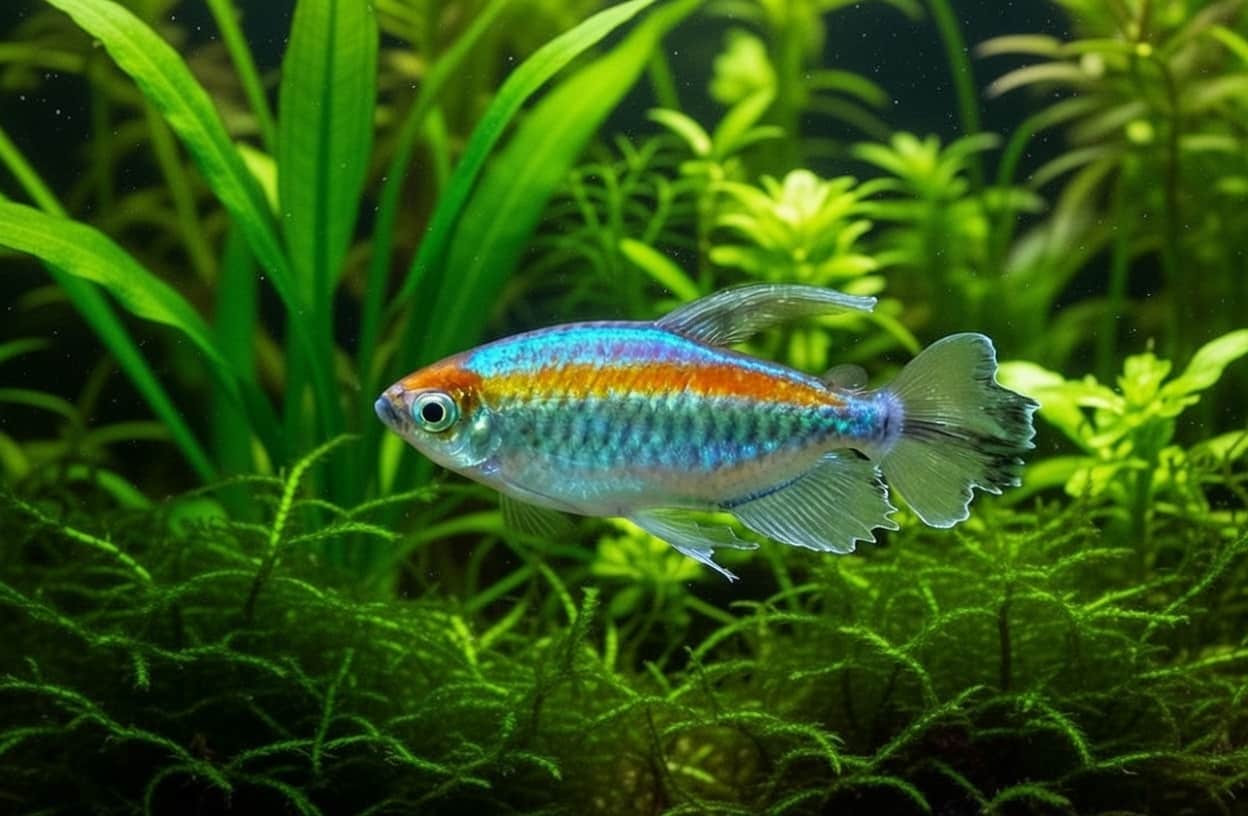
The Congo tetra (Phenacogrammus interruptus) is the show tetra of the freshwater hobby. Males shimmer in shifting waves of blue, gold, orange, and green as they move through the water, with flowing fin extensions that trail behind them like ribbons. At 3 to 3.5 inches, Congo tetras are significantly larger than the neon and cardinal tetras that dominate the hobby, giving them a commanding presence in planted aquariums.
Congo tetras are also the only commonly kept African tetra in the aquarium trade. While the vast majority of popular tetra species — neon tetras, cardinal tetras, ember tetras, rummy-nose tetras — come from South America, Congo tetras originate from the Congo River basin in central Africa. This makes them a genuinely unique addition to any freshwater setup.
This guide covers everything you need to keep Congo tetras healthy and displaying their best coloration: tank setup, water parameters, diet, male vs female differences, schooling requirements, compatible tank mates, and common health issues.
Congo Tetra at a Glance
Congo Tetra
Phenacogrammus interruptus
| Parameter | Value |
|---|---|
| Tank Size | 30+ gallons |
| Temperature | 73-82°F (23-28°C) |
| pH Range | 6.0-7.5 |
| Lifespan | 3-5 years |
| Adult Size | 3-3.5 inches (males) |
| Diet | Omnivore |
| Difficulty | Intermediate |
Tank Setup
Congo tetras are active swimmers that cover the full length of the aquarium. A 30-gallon tank is the minimum for a school of 6, and a longer tank is always better than a taller one — a 36-inch or 48-inch tank provides the horizontal swimming space these fish need. If you plan to keep a school of 8 to 12 (recommended), a 40- to 55-gallon tank gives them room to display proper schooling behavior and allows males to show off their fin extensions without constant competition for space.
Substrate and Decor
Congo tetras display their most vivid iridescence over dark substrates. In the wild, they inhabit murky, vegetation-rich waters over sandy or muddy bottoms. Replicating this in the aquarium brings out the best coloration.
- Black sand or dark gravel — provides the strongest color contrast against their iridescent scales. The most popular choice for Congo tetra setups.
- Planted tank soil (Fluval Stratum, ADA Amazonia) — works well if you are running a planted aquarium. Naturally softens water and lowers pH. See our best substrate for planted tanks for options.
- Fine river sand — mimics their natural habitat and pairs well with driftwood for a more natural look.
Driftwood and rocks provide visual barriers that help reduce tension between competing males. Congo tetras appreciate structure in the tank but need large open areas for swimming.
Plants and Swimming Space
The key to a good Congo tetra setup is balancing cover with open water. Plant the back and sides of the aquarium heavily, but leave the center and front open for the school to move through. Congo tetras spend most of their time swimming at mid-level in the open water column, and they need that space.
This balance matters more than just aesthetics. Congo tetras are naturally skittish, and having dense plants and driftwood to retreat into when startled makes them far more willing to spend time out in the open. Fish that feel exposed with nowhere to hide stay stressed, and chronic stress directly dulls their iridescent coloration. Give them places to retreat and they will reward you by spending more time on display with their best colors showing.
Ideal Tank Setup
- 30-gallon minimum, with 40 to 55 gallons preferred for larger schools
- Long tanks (36 inches or more) rather than tall tanks for horizontal swimming space
- Dark substrate to maximize iridescent coloration
- Heavy planting along back and sides with open swimming space in the center
- Floating plants to diffuse overhead lighting and reduce skittishness
- Driftwood for visual barriers between males
- A lid — Congo tetras are capable jumpers, especially when startled
Hardy Plants Only
Congo tetras occasionally nibble on soft-leaved plants like Cabomba and Hornwort. Stick with hardy species that can handle light grazing: Java fern, Anubias, Amazon sword, and Vallisneria are all good choices. Our low-tech planted aquarium guide covers the hardiest options. If plant nibbling is an issue, increase the vegetable portion of their diet.
Lighting
Congo tetras are naturally skittish and prefer subdued lighting. Bright overhead lights stress them and can cause them to hide behind plants rather than swimming in the open. Floating plants are the easiest solution — they diffuse the light while also making the fish feel more secure. Under moderate, angled lighting, the iridescent coloration of male Congo tetras shifts and shimmers in a way that harsh overhead light cannot replicate.
Filtration
Congo tetras need good water quality with moderate flow. A hang-on-back filter or canister filter works well, providing efficient biological filtration while creating gentle to moderate current. These fish come from rivers and tolerate more flow than many smaller tetra species, but they should not be fighting against strong current in all areas of the tank.
Aim for 4 to 6 times tank volume turnover per hour. A 40-gallon tank needs a filter rated for 160 to 240 gallons per hour. See our best aquarium filter guide for recommendations by tank size.
Water Parameters
Congo tetras are adaptable once established, but they are sensitive to water quality and do not handle ammonia, nitrite, or sudden parameter swings well. Stable, clean water is the single most important factor in keeping Congo tetras healthy and colorful.
Temperature
Aim for 75-80°F (24-27°C). The full tolerance range is 73 to 82°F (23 to 28°C).
- 73-75°F — Lower end. Tolerated but not ideal for long-term coloration and activity.
- 75-80°F — Comfortable range where Congo tetras display their best colors and most active behavior.
- 80-82°F — Upper end. Increases metabolism and may shorten lifespan over extended periods.
An adjustable heater is essential. Congo tetras are tropical fish that cannot tolerate temperature drops below the low 70s.
pH and Hardness
Target pH 6.0-7.5 and hardness of 3-12 dGH. Congo tetras are flexible within this range, and stability matters more than hitting an exact number.
- pH 6.0-6.5 — Closer to their natural habitat. Wild-caught fish tend to show better color in slightly acidic water.
- pH 6.5-7.5 — Well-tolerated by captive-bred stock. No need to chase lower numbers if your tap water falls in this range.
- Hardness 3-12 dGH — Soft to moderately hard water works. Avoid very hard water above 15 dGH.
Fully Cycled Tanks Only
Never add Congo tetras to an uncycled or newly cycled tank. These fish are sensitive to ammonia and nitrite and will show immediate stress in the form of faded coloration, hiding, and rapid breathing. Your aquarium should be fully cycled with stable parameters for at least 4 to 6 weeks before introducing Congo tetras.
Water Change Schedule
Perform 20% water changes weekly to keep nitrates below 20 ppm. Congo tetras are sensitive to nitrate buildup, and neglecting water changes is one of the fastest ways to dull their coloration. Always match the temperature of new water to the tank before adding it.
Male vs Female Congo Tetras
Sexual dimorphism in Congo tetras is dramatic — one of the most pronounced differences of any tetra species. Males and females look so different that beginners sometimes mistake them for separate species.
Males
Male Congo tetras are the showpiece fish. They are larger (3 to 3.5 inches), display intense iridescent coloration that shifts between blue, gold, orange, green, and violet depending on the angle of light, and develop elongated fin extensions that no other common tetra species can match.
- Dorsal fin — tall and flowing, extending well beyond the body
- Caudal (tail) fin — the center rays extend into a distinctive pointed filament
- Anal fin — elongated with a flowing edge
- Coloration — vibrant iridescence across the full body, most intense along the lateral line
These fin extensions develop as males mature and can take 6 to 12 months to fully grow in. Young males at the fish store may not yet display their full finnage.
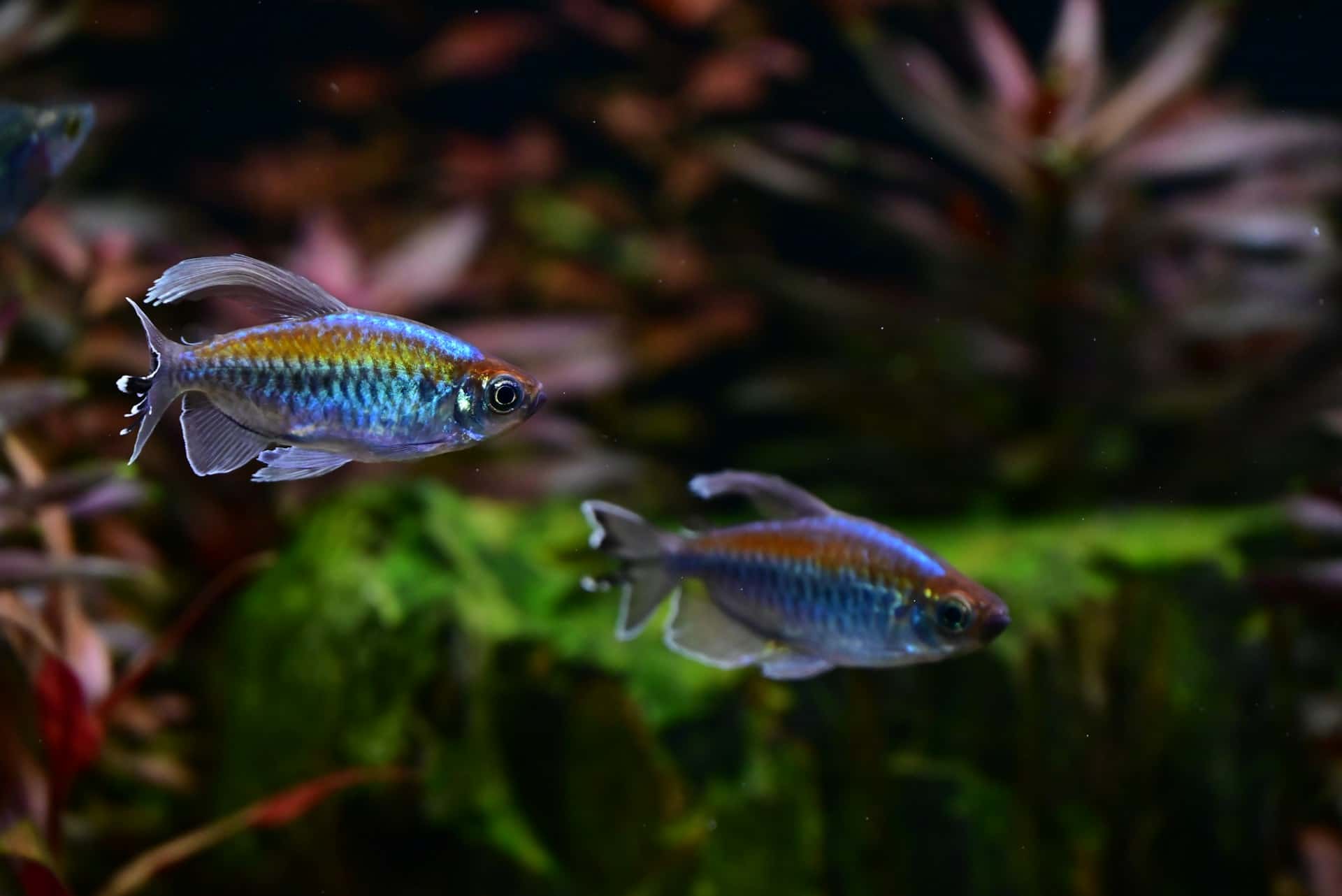
A mature male Congo tetra in full display — the flowing dorsal and caudal fin extensions take 6 to 12 months to fully develop.
Females
Female Congo tetras are smaller (2 to 2.5 inches), less colorful, and lack the elongated fin extensions of males. They display a more subdued golden-green iridescence and have shorter, rounded fins. Females are rounder-bodied than males, particularly when carrying eggs.
Ideal Sex Ratio
Keep a ratio of roughly 2 females to every 1 male. Multiple males will display more intensely as they compete for female attention, but too many males in a small space leads to constant chasing and stress. In a group of 8 Congo tetras, aim for 3 males and 5 females. In a group of 6, keep 2 males and 4 females.
Males Need an Audience
Male Congo tetras display their most vibrant coloration and finnage when females are present. An all-male group will still look impressive, but the fish tend to be less active and display less intensely without females to impress. A mixed-sex group produces the best visual display.
Diet and Feeding
Congo tetras are omnivores with healthy appetites. In the wild, they feed on small insects, worms, crustaceans, algae, and plant matter. They are not picky eaters in captivity and will accept most prepared foods readily.
What to Feed
Recommended Diet
- High-quality flake food or pellets as a daily staple
- Frozen or freeze-dried brine shrimp 2 to 3 times per week
- Frozen or freeze-dried daphnia for variety and digestive health
- Frozen bloodworms as a protein-rich treat once or twice a week
- Blanched spinach, zucchini, or spirulina flakes to satisfy their vegetable-grazing instinct
- Live foods (brine shrimp, daphnia, mosquito larvae) for conditioning and peak coloration
A varied diet is critical for bringing out the full iridescent coloration of Congo tetras. Fish fed only dry food will survive but will not display the shifting blues, golds, and greens that make this species spectacular. Live and frozen foods provide the carotenoid pigments and protein that fuel their best color.
How Often to Feed
Feed Congo tetras twice per day in amounts they can finish within 2 to 3 minutes. Congo tetras are fast, aggressive eaters that will race around the tank to grab food before other species can reach it. If you keep them in a community tank, feed at multiple spots simultaneously to ensure slower tank mates get their share.
Watch for Food Stealing
Congo tetras are fast swimmers and voracious eaters. They will intercept sinking pellets meant for bottom-dwellers like corydoras catfish before the food reaches the substrate. If you keep Congo tetras with bottom-feeders, distract the congos with floating food at one end of the tank while dropping sinking food at the other end.
Schooling Behavior
Congo tetras are a schooling species that should be kept in groups of at least 6. In the wild, they gather in large schools in the open water of rivers and tributaries. This instinct carries into the aquarium — Congo tetras kept in small groups or alone become stressed, lose color, and spend most of their time hiding.
School Size
A minimum of 6 Congo tetras is required, but groups of 8 to 12 produce significantly better behavior and coloration. In larger groups, the fish are more confident, swim in the open more often, and males display more intensely as they compete for female attention. A school of 8 to 10 Congo tetras in a 55-gallon planted tank is one of the most visually impressive freshwater displays available.
Behavior in the Aquarium
Congo tetras are active mid-water swimmers that cover the full length of the tank throughout the day. They school more loosely than species like rummy-nose tetras — rather than tight synchronized formations, they move in a flowing, relaxed group that spreads and contracts as they swim. Males frequently break away to display to females, flaring their fins and showing off their coloration before returning to the group.
Skittishness and Building Confidence
Congo tetras are naturally timid despite their size. Sudden movements outside the tank, loud noises, or aggressive tank mates can send the entire school darting behind the plants. They are reactive enough that a door slamming or someone walking past the tank too quickly can spook them into the glass or decor. Most Congo tetras become significantly more confident after 1 to 2 weeks in a new tank, but only if the environment is set up to support that.
Several factors make the biggest difference in how bold your Congo tetras become:
- School size — This is the single most impactful factor. Keepers with groups of 3 to 5 consistently report constant hiding, while keepers with 10 or more report bold, active fish that school confidently in the open. A group of 8 to 12 is the sweet spot.
- Dense perimeter planting — Heavy plants along the back and sides give Congo tetras escape routes and places to retreat when startled. Knowing they have somewhere to go makes them far more willing to spend time in the open center of the tank.
- Floating plants — Overhead cover from floating plants like Amazon frogbit or water sprite diffuses light and makes the fish feel less exposed from above, which is where predators would come from in the wild.
- Tank placement — Position the tank in a low-traffic area, away from doorways, hallways, and windows facing busy streets. Avoid spots where people or pets regularly walk past. Congo tetras are extremely reactive to movement outside the glass.
- Gradual lighting transitions — Sudden lights-on or lights-off events can cause Congo tetras to slam into the glass or lid in a panic. Use a timer with a ramp-up period, or turn on a room lamp 5 to 10 minutes before switching on the tank light, and reverse the process at night.
- Tannins — Indian almond leaves, driftwood, or alder cones tint the water amber, replicating the blackwater conditions of their natural habitat. The darker water makes them feel less visible and reduces stress.
- Consistent feeding routine — Feed at the same times every day. Congo tetras learn the schedule quickly and begin associating your presence with food rather than danger. In the first week or two, drop the food in and step back — over time they will approach the front glass at feeding time on their own.
- Dither fish — Confident, active tank mates that swim in the open signal to Congo tetras that there is no immediate threat. Corydoras, smaller rainbowfish, and small peaceful tetras all work well as dither fish that draw Congos out of hiding.
Compatible Tank Mates
Congo tetras are peaceful community fish that do not harass or attack other species. Their larger size (compared to most tetras) and active swimming style mean they need tank mates that are not too small to be intimidated and not aggressive enough to damage their flowing fins.
Good Tank Mates
Compatible Species
- Rainbowfish — similar size, temperament, and active swimming style. One of the best pairings.
- Other tetras (neon tetras, cardinal tetras, rummy-nose tetras) — peaceful mid-water schoolers
- Corydoras catfish — peaceful bottom-dwellers that occupy a different zone
- Bristlenose plecos — peaceful algae eaters that stay on surfaces and the substrate
- Kuhli loaches — nocturnal bottom-dwellers that coexist without conflict
- Dwarf cichlids (Apistogramma, German blue rams) — compatible in larger tanks with territory
- Cherry barbs — peaceful, similarly active, and colorful mid-water fish
- Nerite snails and mystery snails — completely peaceful and useful algae cleaners
Congo tetras pair particularly well with rainbowfish. Both species are active mid-water swimmers of similar size, and the combination of iridescent Congo tetras with colorful rainbowfish creates a tank that shimmers from every angle.
Species to Avoid
Incompatible Tank Mates
- Tiger barbs and serpae tetras — notorious fin nippers that will shred Congo tetra fin extensions
- Large aggressive cichlids (oscars, Jack Dempseys, convicts) — will attack or eat Congo tetras
- Chinese algae eaters — become aggressive and territorial with age
- Red-tail sharks and rainbow sharks — territorial and will chase schooling fish
- Very small or timid species in undersized tanks — Congo tetras' fast swimming can stress them
Protect Those Fins
The flowing fin extensions on male Congo tetras are a target for fin-nipping species. Even mildly nippy fish like black skirt tetras can damage the long dorsal and caudal filaments that take months to grow. Avoid all known fin nippers if you want your males to display their full finnage.
Why Are My Congo Tetras Losing Color?
If it happens when the lights first come on, it’s normal. Congo tetras fade their coloration while resting, just like other tetra species. Full iridescence returns within minutes of the lights turning on.
If colors stay dull during the day, check these factors:
- Lighting angle — Congo tetra coloration is iridescent, meaning it depends on the angle of light hitting their scales. Under flat overhead lighting, they look washed out. Angled or diffused lighting produces the best shimmer.
- Substrate too light — Light-colored gravel or bare-bottom tanks cause Congo tetras to pale their coloration. Dark substrates trigger a natural response to intensify pigmentation.
- Stress — School too small, tank too bright, aggressive tank mates, or recent transport. Increase the group and add floating plants.
- Diet — A monotonous dry-food diet dulls their colors. Add frozen brine shrimp, daphnia, and live foods for carotenoid pigments.
- Water quality — Elevated ammonia, nitrite, or high nitrates. Test your water and perform a water change.
Common Health Issues
Congo tetras are reasonably hardy once established in a stable aquarium. Most health problems trace back to poor water quality, stress from inadequate school size, or introducing sick fish without quarantine.
Ich (White Spot Disease)
Ich is the most common disease affecting Congo tetras, presenting as small white dots on the body and fins. Congo tetras are particularly susceptible after temperature drops or during the stress of transport and acclimation. Treatment involves gradually raising the water temperature to 82°F over 48 hours while using an ich medication containing malachite green or formalin. Remove activated carbon from the filter during treatment.
Fin Rot
Fin rot appears as frayed, discolored, or receding fin edges — particularly noticeable on male Congo tetras because of their elongated fins. Fin rot is almost always caused by poor water quality. Improving tank maintenance with more frequent water changes often resolves mild cases. For persistent fin rot, a broad-spectrum antibacterial treatment may be necessary. Damaged fin extensions can regrow, but it takes weeks to months.
Bacterial Infections
General bacterial infections can occur when water quality declines or when fish are immunocompromised from stress. Symptoms include lethargy, loss of appetite, body ulcers, or rapid breathing. The best defense is consistent water quality through regular maintenance and quarantine of new additions.
Disease Prevention
- Maintain stable water quality with weekly 20% water changes
- Quarantine all new fish for 2 to 3 weeks before adding them to the main tank
- Keep nitrates below 20 ppm at all times
- Avoid temperature swings — even 2 to 3 degrees Fahrenheit can trigger stress
- Maintain a school of at least 6 to reduce chronic stress
- Remove dead fish promptly to prevent disease spread
The Only African Tetra You’ll See
While the tetra family spans both South America and Africa, the aquarium hobby is overwhelmingly dominated by South American species. Congo tetras are the standout exception — the one African tetra that has earned a permanent place in the freshwater hobby. They belong to the family Alestidae (African tetras), not Characidae (the family that includes neon and cardinal tetras), though the care requirements are similar enough that they fit right into community tanks alongside their South American relatives.
Congo tetras were first described scientifically in 1899 and have been collected from the Congo River basin in the Democratic Republic of the Congo and the Republic of Congo. They inhabit murky, slow-moving tributaries and marshes with abundant vegetation — conditions that planted aquariums replicate well.
Sources
- FishBase — Phenacogrammus interruptus species profile. Temperature, pH, size, and distribution data.
- SeriouslyFish — Phenacogrammus interruptus care profile. Tank size, diet, behavior, and breeding notes.
- Wikipedia — Congo tetra. Taxonomic classification and habitat overview.
Frequently Asked Questions
How big do Congo tetras get?
Male Congo tetras reach 3 to 3.5 inches in an aquarium, while females stay smaller at around 2.5 inches. Males also develop elongated fin extensions that make them appear even larger. In the wild, Congo tetras can grow slightly bigger, but captive specimens rarely exceed 3.5 inches. They reach full adult size at around 12 to 18 months.
How many Congo tetras should I keep together?
Keep a minimum of 6 Congo tetras, though groups of 8 to 12 produce the best schooling behavior and coloration. A mixed-sex group with roughly 2 females per male reduces aggression from competing males. Larger schools also help Congo tetras feel secure and encourage them to swim in the open rather than hiding among the plants.
Are Congo tetras aggressive?
Congo tetras are peaceful fish that do not attack or harass tank mates. However, mature males can become boisterous during breeding displays, chasing females and occasionally sparring with each other. This behavior is normal and rarely causes injury. Keep a 2:1 female-to-male ratio and provide enough space to minimize tension. Their fast swimming and active nature can stress very timid species.
Can Congo tetras live with small tetras like neons?
Yes, Congo tetras coexist peacefully with smaller tetras like neon tetras, cardinal tetras, and ember tetras. Despite being significantly larger, Congo tetras are not predatory toward small fish. The main consideration is that Congo tetras are fast, active swimmers that may outcompete slower fish for food. Feed at multiple spots in the tank to ensure everyone eats.
Do Congo tetras eat plants?
Congo tetras occasionally nibble on soft-leaved plants, particularly fine-leaved species like Cabomba and Hornwort. This is more of an occasional grazing behavior than destructive plant eating. Hardy plants like Java fern, Anubias, Amazon sword, and Vallisneria are generally left alone. If plant nibbling becomes an issue, increasing the vegetable portion of their diet (blanched spinach, spirulina flakes) often reduces it.
Why are my Congo tetras hiding?
Congo tetras are naturally skittish fish that hide when they feel insecure. The most common causes are a school that is too small (under 6), a tank that is too bright without floating plants, aggressive or very active tank mates, or a new environment they have not adjusted to yet. Increase the school size, add floating plants to dim the lighting, and give them time to settle in. Most Congo tetras become confident within 1 to 2 weeks.
How long do Congo tetras live?
Congo tetras typically live 3 to 5 years in a well-maintained aquarium. Lifespan depends on water quality, diet variety, stress levels, and the quality of the fish when purchased. Maintaining stable water parameters and feeding a varied diet that includes live or frozen foods gives Congo tetras the best chance at a full lifespan.
Do Congo tetras need a heater?
Yes. Congo tetras are tropical fish that need water temperatures between 73 and 82 degrees Fahrenheit, with 75 to 80 degrees being the ideal range. Most homes cannot maintain this consistently without a heater, especially overnight. An adjustable aquarium heater set to 77 degrees Fahrenheit is recommended, along with a separate thermometer to verify accuracy.
Found this helpful?
Share this guide with your fellow aquarium enthusiasts!

Written by
Jonathan Jenkins
I've been keeping fish for over 15 years — everything from planted freshwater tanks to saltwater reefs. I currently have a 30 gallon overstocked guppy breeding tank, 40 gallon planted self-cleaning aquarium, 200 gallon reef tank, and 55 gallon frag tank. I joined Fish Tank World to continue learning while sharing what I've learned along the way.