
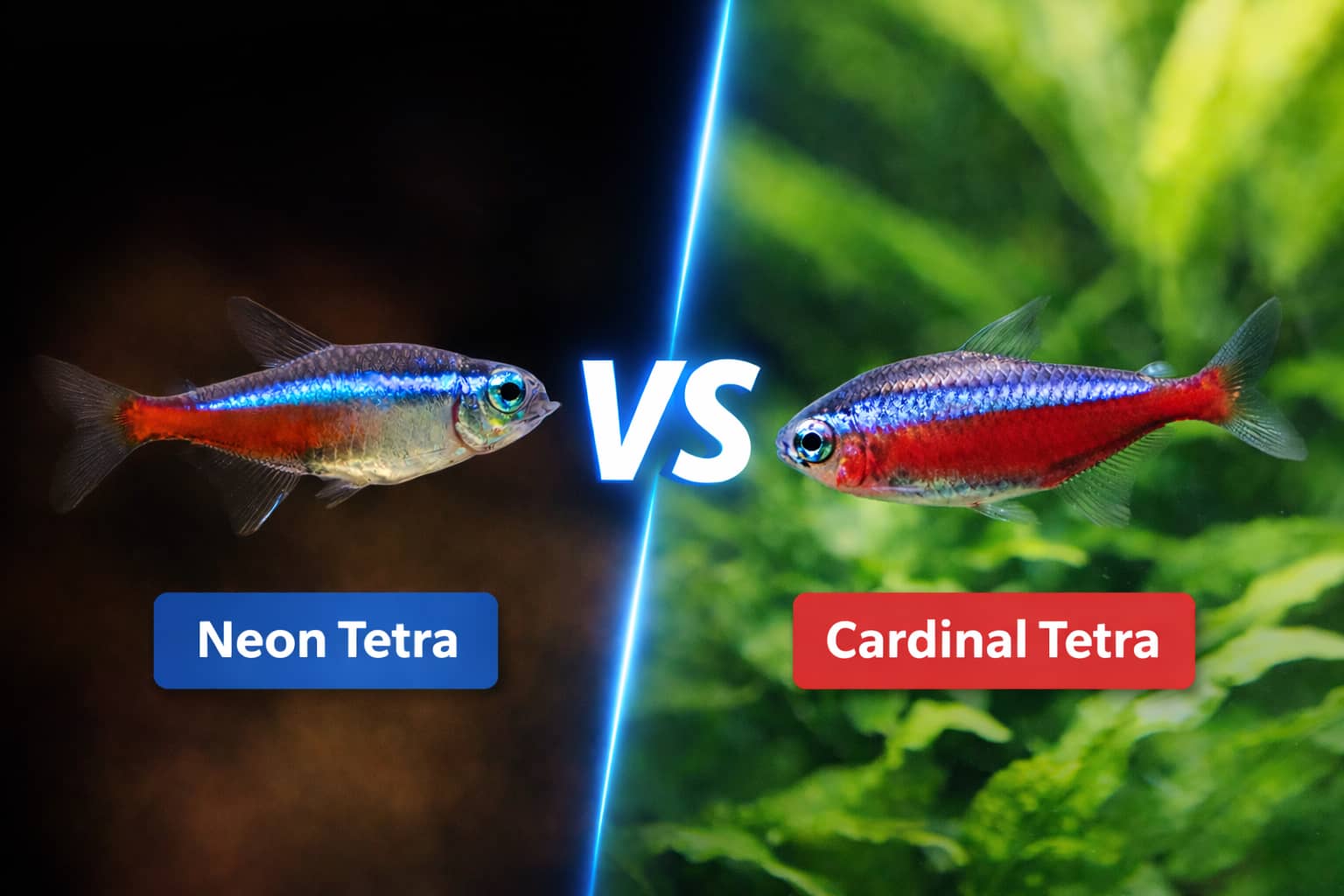
Cardinal tetras (Paracheirodon axelrodi) and neon tetras (Paracheirodon innesi) are two of the most popular freshwater aquarium fish in the world. At first glance, they look almost identical — a flash of iridescent blue over a band of red, darting through a planted tank in a tight school. But these are two distinct species with real differences in color, hardiness, care requirements, and price that can affect which one is the better fit for your aquarium.
If you are setting up a new tank or deciding between these two species for your next school of fish, this comparison breaks down everything you need to know to make the right choice.
Side-by-Side Comparison
| Cardinal Tetra | Neon Tetra | |
|---|---|---|
| Scientific Name | Paracheirodon axelrodi | Paracheirodon innesi |
| Adult Size | Up to 2 inches | Up to 1.5 inches |
| Red Stripe | Full body (eye to tail) | Back half only (mid-body to tail) |
| Temperature | 73-84°F (75-81°F ideal) | 68-82°F (73-77°F ideal) |
| pH Range | 5.5-7.0 | 6.0-7.5 |
| Lifespan | 4-5+ years | 5-8 years (often 2-3 in practice) |
| Hardiness | Hardy once acclimated | More adaptable to varied water |
| Difficulty | Intermediate | Beginner |
| Price | Higher | Lower |
| Source | Mostly wild-caught | Mostly captive-bred |
Appearance Differences
The easiest way to tell these two species apart is the red stripe. On a cardinal tetra, the red band extends the full length of the lower body, running from just behind the eye all the way to the tail. On a neon tetra, the red stripe only covers the back half of the body, starting at mid-body and continuing to the tail. The front half of a neon tetra’s belly is silvery white, while a cardinal tetra’s belly is almost entirely red.
Both species share the brilliant iridescent blue-green stripe that runs horizontally along the upper body. This stripe reflects light, which is why both fish seem to glow under aquarium lighting and appear dull or faded in the dark.
Cardinal tetras are also slightly larger than neon tetras. An adult cardinal reaches about 2 inches in length, while an adult neon maxes out around 1.5 inches. The difference is subtle but noticeable when you see both species side by side.
Quick ID Trick
Look at the belly. If the red runs the full length of the fish from head to tail, it is a cardinal tetra. If the front half of the belly is white or silver, it is a neon tetra. This is the fastest and most reliable way to tell them apart, even in a busy fish store tank.
In terms of color intensity, most fishkeepers find that cardinal tetras display richer, deeper reds and blues. Their full-body red stripe creates a more dramatic visual impact, especially in a planted tank with dark substrate. Neon tetras are still beautiful, but their colors can fade more noticeably with age — particularly in mass-bred specimens.
Cardinal Tetra Care Parameters
Cardinal Tetra
Paracheirodon axelrodi
| Parameter | Value |
|---|---|
| Tank Size | 20+ gallons |
| Temperature | 73-84°F (75-81°F ideal) |
| pH Range | 5.5-7.0 |
| Lifespan | 4-5+ years |
| Adult Size | 2 inches |
| Diet | Omnivore |
| Difficulty | Intermediate |
Cardinal tetras originate from the blackwater tributaries of the Rio Negro and upper Orinoco River basins in South America. These waters are extremely soft, acidic, and stained dark brown with tannins from decomposing leaves and wood. This origin shapes their care requirements — they do best in soft, acidic water and warmer temperatures than many common community fish. For a deep dive into cardinal tetra husbandry, see the full cardinal tetra care guide.
Neon Tetra Care Parameters
Neon Tetra
Paracheirodon innesi
| Parameter | Value |
|---|---|
| Tank Size | 10+ gallons |
| Temperature | 68-82°F (73-77°F ideal) |
| pH Range | 6.0-7.5 |
| Lifespan | 5-8 years |
| Adult Size | 1.5 inches |
| Diet | Omnivore |
| Difficulty | Beginner |
Neon tetras come from the tributaries of the Amazon basin across Brazil, Colombia, and Peru. While their natural habitat is also soft and acidic, decades of captive breeding have made them significantly more adaptable. Modern captive-bred neons tolerate a wider pH range and handle moderately hard water far better than cardinals do. For a deep dive into neon tetra husbandry, see the full neon tetra care guide.
Hardiness and Care Level
This is where the comparison gets interesting, and where community opinion often splits.
Neon tetras are more adaptable. After generations of captive breeding, they handle a broader range of water parameters. If your tap water runs neutral to slightly alkaline with moderate hardness, neon tetras will adjust more easily. They are the safer pick for a beginner who may not have perfectly dialed-in water chemistry yet.
Cardinal tetras are often hardier once acclimated. This sounds contradictory, but the explanation is straightforward. Most cardinal tetras are wild-caught, meaning they have not been weakened by generations of mass breeding. Once you get them through the acclimation period and into stable, suitable water conditions, they tend to be robust and resistant to disease.
The challenge with cardinals is that initial acclimation period. Wild-caught fish are stressed from capture and transport, and they are accustomed to very specific water chemistry. Moving them into water that is too hard or alkaline can cause problems. Drip acclimation over 1 to 2 hours is recommended when bringing cardinals home.
Neon Tetra Disease
Both species can contract neon tetra disease (NTD), caused by the parasite Pleistophora hyphessobryconis. Despite the name, cardinals are not immune. However, neon tetras from large commercial farms tend to be more susceptible due to weakened immune systems from intensive breeding. There is no cure for NTD — quarantining new fish for 2 to 3 weeks before adding them to your main tank is the most effective prevention.
The mass-breeding issue with neon tetras is well-documented in the fishkeeping community. Many hobbyists report buying a school of neons only to lose several within the first few weeks, regardless of water quality. This is not a universal experience — healthy neon stock from reputable breeders or local fish stores that quarantine their fish can be perfectly robust. But it is common enough that many experienced aquarists have shifted to preferring cardinals for their long-term reliability.
Lifespan
On paper, neon tetras can live 5 to 8 years in a well-maintained aquarium. In practice, many hobbyists report lifespans of just 2 to 3 years, often due to the health issues associated with mass-bred stock.
Cardinal tetras typically live 4 to 5 years, with some individuals reaching 6 years or beyond under optimal conditions. Because they are generally healthier at the point of purchase, their real-world lifespans tend to be more consistent and predictable.
The takeaway: neon tetras have a higher theoretical ceiling, but cardinal tetras are more likely to actually reach their full lifespan potential.
Price and Availability
Neon tetras are cheaper and more widely available. You can find them at virtually every pet store and aquarium shop. They are one of the most mass-produced aquarium fish in the world.
Cardinal tetras typically cost double or more than neons and are not always in stock at mainstream pet stores. Their higher price reflects the cost of wild-catching and importing them from South America, plus a higher mortality rate during shipping compared to farm-bred neons.
Cost Considerations
- Expect to pay double or more per fish for cardinals over neons
- Factor in survival rates: losing a few neons early on from weak stock narrows the price gap
- Cardinals from a reputable source are often the better long-term investment
- Buying locally bred neons (if available) can avoid the mass-bred health issues
Tank Requirements
Both species thrive in planted tanks with subdued lighting and gentle filtration. Their needs overlap significantly, but there are some notable differences.
Tank size: Neon tetras can work in a 10-gallon tank for a small school of 6. Cardinal tetras do better with a 20-gallon minimum because they prefer more swimming space and the larger water volume provides more stable parameters.
Temperature: Cardinals are comfortable at 75-81°F, while neons handle a wider range of 70-81°F. Cardinals tolerate warmer water than neons, so they are sometimes kept with species like discus or German blue rams — though this pushes them toward the upper end of their comfort zone. Neon tetras are more flexible and compatible with a broader range of community fish that prefer the 74-78°F sweet spot.
Water chemistry: Cardinal tetras thrive in soft, acidic water with a pH of 5.5 to 7.0. Neon tetras prefer 6.0 to 7.5 and tolerate moderately hard water well. If your water is hard or alkaline, neon tetras are the more practical choice unless you are willing to use reverse osmosis water or other methods to soften it.
Ideal Tank Setup for Both Species
- Dark substrate (black sand or dark gravel) to bring out the best coloration
- Dense planting along the back and sides with open swimming space in the center
- Floating plants to diffuse lighting and create shaded areas
- Driftwood and Indian almond leaves for natural tannins (especially beneficial for cardinals)
- Gentle filtration — sponge filters or baffled hang-on-back filters
- A reliable heater to maintain stable temperatures
If you are starting a new aquarium, make sure it is fully cycled before adding either species. Both neon and cardinal tetras are sensitive to ammonia and nitrite spikes, and adding them to an uncycled tank is one of the most common reasons new fishkeepers lose their first school.
Tank Mates
Cardinal tetras and neon tetras are both peaceful schooling fish that work well in community setups. Their tank mate lists overlap almost completely, with one important caveat: cardinals prefer warmer water, which narrows the field slightly. For more options, see the full guide to the best tetras for community tanks.
Good Tank Mates for Both Species
- Corydoras catfish (Sterbai cories for cardinals, most species for neons)
- Harlequin rasboras
- Other small tetras (ember tetras, rummy-nose tetras, black neon tetras)
- Otocinclus catfish
- Kuhli loaches
- Cherry shrimp and Amano shrimp
- Small peaceful gouramis (honey gouramis, sparkling gouramis)
- Nerite snails and mystery snails
Species to Avoid
- Angelfish — natural predators of small tetras despite being sold alongside them
- Cichlids (oscars, Jack Dempseys, convicts) — will eat tetras
- Large barbs (tiger barbs, tinfoil barbs) — fin nippers and too aggressive
- Goldfish — require cooler water and will eat small fish as they grow
- Bettas — territorial and may attack schooling fish in close quarters
Looking beyond tetras? See the best community tank tetras for our full species rankings.
Can You Keep Them Together?
Yes. Cardinal tetras and neon tetras can coexist in the same aquarium without any issues. They occupy the same water column (middle level), eat the same foods, and have overlapping parameter needs. In some tanks, they will even loosely school together, though each species generally prefers to group with its own kind.
If you want to keep both, aim for at least 6 of each species so that each group can form a proper school. A 20-gallon tank or larger gives both schools enough space to move naturally. Set your water parameters to the overlap zone — a temperature of 75-78°F and a pH around 6.0-6.5 — and both species will do well.
Mixed Schools
While cardinals and neons may swim near each other, they do not truly school together the way members of the same species do. Each group will form its own loose cluster.
Which Should You Choose?
The right choice depends on your experience level, water conditions, and priorities.
Choose neon tetras if:
- You are new to fishkeeping and want a forgiving species
- Your water is neutral to slightly alkaline (pH 6.5-7.5)
- You are working with a smaller tank (10-15 gallons)
- Budget matters and you want an affordable school
- You want the widest possible selection of compatible tank mates
Choose cardinal tetras if:
- You have some experience and can maintain stable, soft water
- Your water is naturally soft and acidic, or you use RO water
- You prioritize the richest possible coloration in your tank
- You are keeping warm-water species like discus or German blue rams
- You want fish that are less likely to arrive with health issues from mass breeding
There is no wrong answer here. Both species are stunning, peaceful, and rewarding to keep. Neon tetras offer a lower barrier to entry and wider compatibility, while cardinal tetras deliver bolder color and tend to be more robust once settled in. Many fishkeepers start with neons, fall in love with the look, and eventually try cardinals — and plenty end up keeping both.
Whichever you choose, give them a properly cycled tank, keep them in a school of 6 or more, maintain stable water conditions, and feed a varied diet. Do that, and you will have a healthy, colorful school that brings your aquarium to life for years to come.
Frequently Asked Questions
What is the main difference between cardinal tetras and neon tetras?
The most visible difference is the red stripe. Cardinal tetras have a red band that runs the full length of their body from eye to tail, while neon tetras only have red on the back half of their body from mid-body to the tail. Cardinals are also slightly larger, reaching about 2 inches compared to 1.5 inches for neons.
Are cardinal tetras harder to keep than neon tetras?
Cardinal tetras require more stable water conditions and prefer softer, more acidic water than neon tetras. Neon tetras have been captive-bred for decades and tolerate a wider range of water parameters, making them more forgiving for beginners. However, once properly acclimated, cardinals are generally healthy and long-lived.
Can you keep cardinal tetras and neon tetras together?
Yes, you can keep both species in the same tank. They have overlapping water parameter needs and similar temperaments. They may even loosely school together, though each species tends to prefer grouping with its own kind. Aim for at least 6 of each species and provide a tank of 20 gallons or larger.
Why are my neon tetras dying but not my cardinal tetras?
Neon tetras from large fish farms can have weaker immune systems due to mass breeding. They are also more susceptible to neon tetra disease. Cardinal tetras are often wild-caught or bred in smaller operations, which tends to produce hardier fish. Water quality issues, stress, and disease all hit weakened neon stock harder.
Which tetra has better color, cardinal or neon?
Most fishkeepers agree that cardinal tetras display richer, more vivid coloration. Their full-body red stripe creates a bolder visual impact, especially in a planted tank with dark substrate. Neon tetras are still striking, but their colors can fade more with age, particularly in mass-bred specimens.
How many cardinal or neon tetras should I keep together?
Both species are schooling fish that need a minimum of 6 individuals to feel secure. Groups of 10 or more produce the best schooling behavior and coloration. A single tetra or a group of 2 to 3 will be stressed, hide constantly, lose color, and become more susceptible to disease.
Do cardinal tetras live longer than neon tetras?
Cardinal tetras typically live 4 to 5 years in a well-maintained aquarium, and some reach 6 years or more. Neon tetras can live 5 to 8 years under ideal conditions, but many hobbyists report lifespans of just 2 to 3 years due to poor stock quality from mass breeding. In practice, cardinals often outlast neons.
Are cardinal tetras wild-caught?
Most cardinal tetras sold in the aquarium trade are wild-caught from the Rio Negro and Orinoco river basins in South America. They are notoriously difficult to breed in captivity. Captive-bred cardinals do exist but are less common and tend to be more expensive. Wild-caught cardinals need careful acclimation to aquarium conditions.
Found this helpful?
Share this guide with your fellow aquarium enthusiasts!

Written by
Jonathan Jenkins
I've been keeping fish for over 15 years — everything from planted freshwater tanks to saltwater reefs. I currently have a 30 gallon overstocked guppy breeding tank, 40 gallon planted self-cleaning aquarium, 200 gallon reef tank, and 55 gallon frag tank. I joined Fish Tank World to continue learning while sharing what I've learned along the way.