
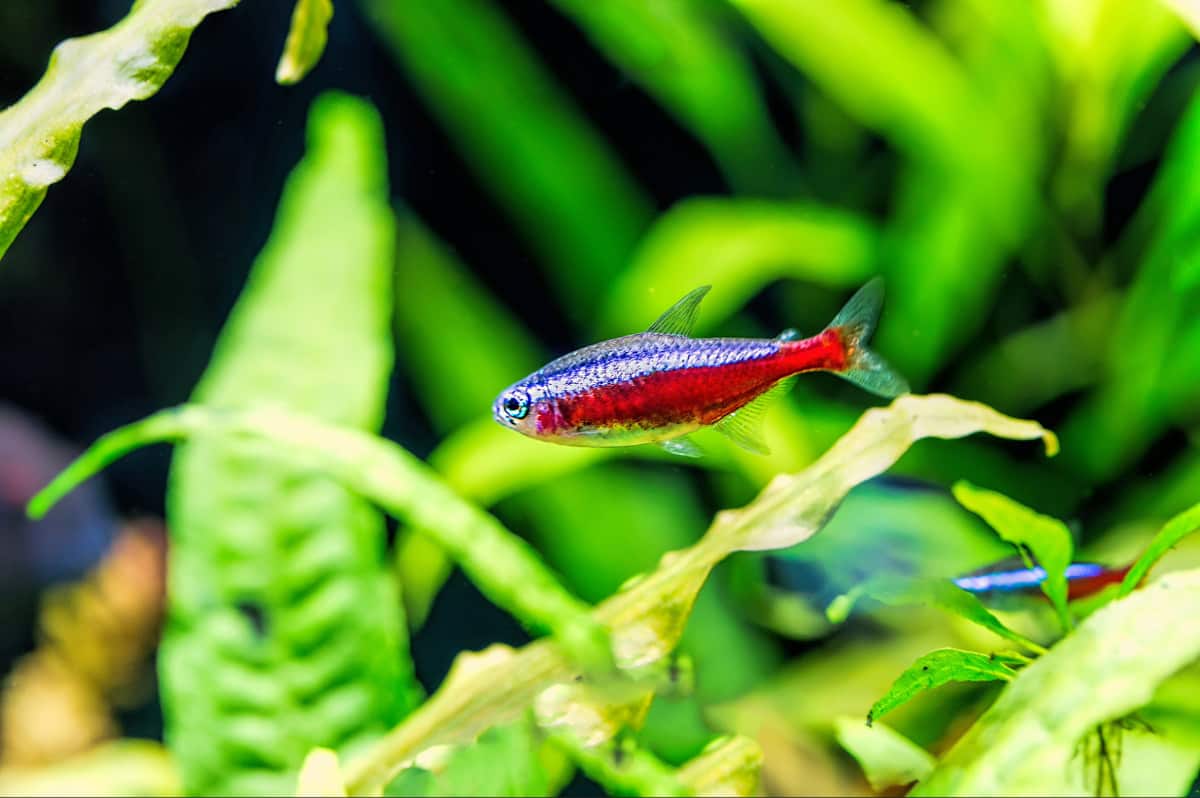
The cardinal tetra (Paracheirodon axelrodi) is often called the more beautiful cousin of the neon tetra, and it is easy to see why. Where the neon’s red stripe only covers the back half of its body, the cardinal tetra’s vivid red band runs the entire length — from the eye to the tail — creating a bolder, more striking display. An iridescent blue line sits directly above, shimmering under aquarium lighting in a way that stops people mid-step when they walk past the tank.
Native to the blackwater tributaries of the Rio Negro and Orinoco river basins in South America, cardinal tetras have a wildness to them that sets them apart from most commonly available aquarium fish. The vast majority of cardinals sold in the hobby are still wild-caught, harvested by local fishermen using hand nets from dugout canoes — a sustainable fishery that has been operating for over 70 years. This wild origin makes them slightly more demanding than captive-bred species, but it also gives them a vigor and color intensity that farm-raised fish often lack.
This guide covers everything you need to keep cardinal tetras healthy and thriving: tank setup, water parameters, diet, schooling needs, compatible tank mates, common health issues, and the realities of breeding this notoriously difficult species.
Cardinal Tetra at a Glance
Care Requirements
Cardinal tetras are often compared to their close relative, the neon tetra. The easiest way to tell them apart is the red stripe — on cardinals it runs the full length of the body, while on neons it only covers the back half. They also differ in size, origin, and water preferences. For a full side-by-side breakdown, see our cardinal tetra vs neon tetra comparison.
Ideal Tank Setup
Cardinal tetras look their best and behave most naturally in setups that reflect their wild habitat — the dark, tannin-stained blackwater streams of the Amazon basin. You do not need a full biotope to keep them healthy, but leaning into a blackwater aesthetic rewards you with bolder colors and more confident behavior.
Substrate and Decor
Dark substrates bring out the best coloration in cardinal tetras. Black sand, dark gravel, or aquasoil provides strong visual contrast against their red and blue stripes and mimics the leaf-littered riverbeds of their natural habitat.
Ideal Tank Features
- Dark substrate (black sand or dark aquasoil) to enhance coloration
- Driftwood and tangled roots to create structure and release beneficial tannins
- Indian almond leaves or dried leaf litter to naturally tint the water and lower pH
- Dense planting along the back and sides with open swimming space in the center
- Floating plants (Water Lettuce, Salvinia, Amazon Frogbit) to diffuse overhead lighting
- Gentle filtration — sponge filters or adjustable hang-on-back filters with reduced flow
Lighting
Cardinal tetras come from shaded forest streams where the tree canopy blocks most direct sunlight. In the aquarium, they do best under subdued lighting — and there’s research to back this up. Linhares et al. (2018) found that cardinal tetras kept at low light levels (0-250 lux) developed denser melanophores in their black and blue stripes, producing noticeably more vibrant coloration. Under intense light, those same stripes faded as melanophore density dropped — a natural camouflage response that likely helps them avoid predators in the wild.
Floating plants are the simplest way to get light levels right. They diffuse overhead lighting while also making the fish feel more secure and willing to swim in the open. If you’re growing live plants in a cardinal tetra tank, see our best LED lights for planted tanks for lighting that balances plant growth with the subdued conditions cardinals prefer.
The Blackwater Advantage
Adding Indian almond leaves, alder cones, or a commercial blackwater extract to the tank creates the tannin-stained water that cardinals naturally inhabit. Beyond the visual appeal, tannins have mild antibacterial and antifungal properties that benefit wild-caught fish still adjusting to captivity. The amber-tinted water also subdues the lighting naturally, which encourages cardinals to swim in the open rather than hiding among the plants.
Aquarium Size
A 20-gallon tank is the minimum for a school of cardinal tetras. A 20-gallon long (30 inches wide) is preferable to a standard 20-gallon tall because it provides more of the lateral swimming room they use in the wild. If you plan to keep a larger school of 15 to 20 or more, a 30- to 40-gallon tank gives them room to display proper schooling behavior.
Water Chemistry
Water chemistry is where cardinal tetra care diverges most from other common community fish. Cardinals evolved in some of the softest, most acidic freshwater on earth — the blackwater tributaries of the Rio Negro, where pH can drop below 5.0 and general hardness is often near zero.
Temperature
Aim for 75-81°F (24-27°C) for most setups. The full tolerance range is 73 to 84°F (23 to 29°C), and lab studies suggest they can handle well beyond that physiologically.
- 73-75°F — Lower end. Fine for general care, but less ideal for long-term color and activity.
- 75-81°F — Comfortable range. Most care sources and hobbyists recommend somewhere in here, with 77°F as a common target.
- 82-84°F — Tolerated, but the upper end of their comfort zone. Not ideal for long-term care.
An adjustable heater is essential for maintaining stable temperatures.
pH
A pH of 5.5-7.0 suits most cardinal tetra setups. Their tolerance is wider than many care guides suggest — Anjos et al. recorded 100% survival across pH 4.0-8.5 in laboratory conditions.
- Below 5.0 — Deep blackwater territory. Wild cardinals live here naturally, but unnecessary in the aquarium.
- 5.5-7.0 — Where most keepers see the best results. Wild-caught fish tend to settle in more comfortably at the lower end of this range.
- 7.0-7.6 — Tank-bred cardinals generally adapt well here. Burkhart, Crow & Keeley note tank-bred specimens accept pH 7.0 without issue and may adapt to 7.6.
Stability matters more than hitting a precise number. If your tap water is neutral to slightly alkaline, slow acclimation is more important than chasing a lower pH with buffers.
Hardness
Target 4-10 dGH. Cardinal tetras come from some of the softest water on earth, but aquarium-kept fish — especially tank-bred — handle a broader range than their wild habitat suggests.
- 1-3 dGH — Close to wild conditions. Only necessary for breeding attempts.
- 4-10 dGH — Comfortable range for most aquarium-kept cardinals.
- 10-12 dGH — Upper end. Some fish adapt, but softer is generally better for this species.
Burkhart, Crow & Keeley specifically advise against adding calcium or magnesium salts, or using stones that may leach minerals into the water.
Wild-Caught Acclimation Is Critical
Because most cardinal tetras are wild-caught, they arrive at your local fish store after a long journey from South America — often stressed, sometimes weakened, and acclimated to very different water than what comes out of your tap. Never rush the acclimation process. Drip acclimate new cardinal tetras over 1 to 2 hours to gradually adjust them to your water chemistry. This is especially important if your tank water is harder or more alkaline than the soft, acidic conditions they were shipped in. Many early cardinal tetra deaths trace directly to acclimation shock.
Water Quality
Cardinal tetras are sensitive to dissolved waste, particularly nitrite. Anjos et al. found the lethal concentration for nitrite is just 1.1 mg/L — making it the single most dangerous water quality parameter for this species. Keep ammonia and nitrite at 0 ppm at all times, and nitrate below 20 ppm through regular maintenance.
Perform 20% water changes weekly, and always match the temperature of replacement water to the tank before adding it. Never add cardinal tetras to an uncycled or newly cycled aquarium — wait until the tank has been running with stable parameters for at least a month. The same study noted that historical mortality rates during export from the Amazon run as high as 40-50%, largely due to ammonia and nitrite buildup during transport.
Feeding
In the wild, cardinal tetras are micropredators — they spend their days hunting tiny crustaceans, insect larvae, and zooplankton among leaf litter and flooded forest roots. This protein-heavy natural diet is worth keeping in mind when feeding them in captivity.
What to Feed
Frozen and live foods should make up a larger part of a cardinal tetra’s diet than for many other community fish. Wild-caught cardinals especially may refuse prepared foods at first, and offering live baby brine shrimp or daphnia during the first week can help them start eating.
Recommended Diet
- Frozen brine shrimp and daphnia as regular staples — 3 to 4 times per week
- Live baby brine shrimp or daphnia for newly arrived wild-caught fish and conditioning
- High-quality micro pellets as a convenient daily option once fish are eating well
- Frozen bloodworms as an occasional protein-rich treat (once or twice a week)
- Micro worms for very small or recently arrived specimens that won't take other foods
How to Feed
Feed once or twice per day in small amounts they finish within 1 to 2 minutes. Cardinal tetras have tiny mouths — if pellets are too large, they’ll ignore them. Crush or choose micro-sized granules.
Uneaten food is a bigger concern with cardinals than with hardier species. Wild-caught fish are more sensitive to the ammonia spikes that decomposing food creates. Some experienced keepers skip one feeding day per week, which mimics the natural variability of food availability in blackwater streams. A varied diet heavy on frozen and live foods keeps cardinals in peak coloration — fish fed only flakes will survive but won’t display the intense reds and blues this species is known for.
Schooling Behavior
Cardinal tetras are obligate schooling fish. In the wild, they gather in enormous groups — sometimes numbering in the thousands — for protection against predators. This behavior is hardwired, not optional.
Minimum School Size
Keep a minimum of 8 cardinal tetras, though groups of 12 to 20 produce noticeably better behavior and visual impact. A school of 6 is survivable but often results in fish that drift apart, school loosely, and display less vibrant coloring. In groups of 15 or more, you begin to see the synchronized, flowing movement that makes cardinal tetras one of the most visually spectacular freshwater fish available.
The Visual Impact of Large Schools
A school of 20 or more cardinal tetras moving together through a planted, blackwater-tinted tank is one of the most breathtaking sights in the freshwater hobby. The combined effect of dozens of red and blue stripes flowing in unison against dark water and green plants is something that photographs cannot fully capture. If your tank size allows it, investing in a larger school is always worth it.
A cardinal tetra kept alone or in a group of 2 to 3 will be chronically stressed — hiding behind plants, refusing food, losing color, and becoming highly susceptible to disease. If you cannot maintain at least 8, this is not the right species for your setup.
Behavior in the Aquarium
Cardinal tetras occupy the middle water column, spending most of their time swimming at mid-level between the substrate and the surface. They are peaceful, non-aggressive fish that ignore other species entirely. Within the school, there is no dominance hierarchy or fin-nipping — just coordinated movement and shared spatial awareness.
When startled, the school will cluster tightly together and move as a single unit. During calm periods, they may spread out loosely through the planted areas before regrouping when they detect movement outside the tank. This alternation between tight schooling and relaxed dispersal is natural and healthy.
Compatible Tank Mates
Cardinal tetras are excellent community fish. Their peaceful temperament, mid-water swimming zone, and tolerance for warmer temperatures make them compatible with a wide range of similarly peaceful species.
Compatible Tank Mates
Good Tank Mates
- Rummynose tetras — similar water preferences and schooling behavior
- Ember tetras — tiny, peaceful, and comfortable in the same temperature range
- Corydoras catfish — peaceful bottom-dwellers that occupy a different zone
- Otocinclus — small, gentle algae grazers that ignore other fish
- Hatchetfish — surface dwellers that fill the top water zone
- Kuhli loaches — nocturnal bottom dwellers that stay out of the way
- Apistogramma dwarf cichlids — compatible in larger tanks with adequate territory
- Pencilfish — quiet mid-water swimmers from similar habitats
Corydoras are a natural pairing — they fill the bottom of the tank while cardinals occupy the mid-water. Most corydoras species share the same preference for soft, slightly acidic water. Congo tetras also work well in larger tanks — their African origin gives them different coloration that complements cardinals beautifully.
Tank Mates to Avoid
Incompatible Tank Mates
- Large cichlids (oscars, Jack Dempseys, convicts) — will eat cardinal tetras
- Tiger barbs and other aggressive barb species — persistent fin nippers
- Large angelfish — adults will prey on small tetras, despite being sold alongside them
- Goldfish — require cooler, harder water and will eat small fish as they grow
- Red-tail sharks and rainbow sharks — territorial and intimidating to small schooling fish
When building a community tank, always match cardinal tetras with species that share their preference for peaceful temperament, soft water, and moderate to warm temperatures. Their small size makes them vulnerable to any fish with predatory instincts.
Why Is My Cardinal Tetra Losing Color?
If it happens when the lights first come on, it’s normal. Like most small fish, cardinal tetras fade their coloration while resting as a natural defense in the dark. Full color typically returns within minutes.
If colors stay faded during the day, a few things to check:
- Lighting too bright — Research by Linhares et al. (2018) found that intense light directly reduces melanophore density in cardinal tetras, causing the black and blue stripes to pale. Interestingly, the red stripe can actually intensify under bright light. Lower your lighting or add floating plants.
- Acclimation stress — Newly arrived wild-caught cardinals often look washed out for days or even weeks while adjusting. Give them time, dim lighting, and stable water.
- Water quality — Ammonia or nitrite above zero, or a sudden pH swing. Test your water.
- School too small — Cardinals in groups under 6 tend to hide, stress, and lose color. Increase the group if possible.
The quick rule: pale at lights-on is normal. Pale during the day with behavioral changes means investigate.
Common Health Issues
Cardinal tetras are generally hardy once properly acclimated and settled into a stable tank. However, their wild-caught origins and the stress of long-distance transport make the first few weeks the most vulnerable period.
Transport Stress
The most common cause of early death in cardinal tetras is stress from capture and transport. These fish are caught by hand in the Amazon basin, held in collection facilities, shipped to international distributors, forwarded to local fish stores, and then sold to hobbyists — all within a period of days to weeks. Each step introduces handling, water chemistry changes, and confinement stress.
Reducing Transport Stress
- Buy from stores that have held the fish for at least one to two weeks — avoid fish that arrived the same day
- Drip acclimate over 1 to 2 hours to minimize osmotic shock
- Quarantine new arrivals for 2 to 4 weeks before adding them to the main tank
- Keep lights dim during the first 24 to 48 hours after introduction
- Avoid feeding for the first 12 to 24 hours to let them settle
Neon Tetra Disease
Despite the name, neon tetra disease (caused by the microsporidian parasite Pleistophora hyphessobryconis) can theoretically affect cardinal tetras. However, research and hobbyist experience consistently indicate that cardinal tetras are significantly more resistant to this parasite than neon tetras. While no species is completely immune, neon tetra disease is a far less common concern in cardinal tetra populations than it is in neons.
The more pressing health risks for cardinal tetras are ich, bacterial infections, and the effects of improper acclimation — not neon tetra disease.
Ich (White Spot Disease)
Ich is a parasitic infection that appears as small white dots on the body and fins, resembling grains of salt. Cardinal tetras are susceptible to ich during periods of stress — particularly after transport or when exposed to temperature fluctuations. Treatment involves gradually raising the water temperature to 82 to 84°F (which is within their comfort range) and using an ich medication containing malachite green or formalin. Remove carbon from the filter during treatment.
Bacterial Infections
Fin rot, body ulcers, and general bacterial infections can occur when water quality declines or when fish are immunocompromised from stress. The best defense is consistent water quality through regular maintenance, prompt removal of dead fish, and quarantine of new additions.
Quarantine All New Cardinals
Because cardinal tetras are wild-caught and undergo significant transport stress, quarantining new arrivals is not optional — it is essential. A bare-bottomed quarantine tank of 10 gallons with a sponge filter, heater, and dim lighting gives new fish time to recover and allows you to observe for signs of disease before they reach your main tank. Two to four weeks of quarantine prevents the vast majority of disease introductions.
The Sustainable Wild Fishery
Most cardinal tetras in the aquarium trade are wild-caught — and that’s actually a good thing. The wild cardinal tetra fishery in the Rio Negro region of Brazil employs tens of thousands of local families, known as piabeiros, who collect the fish sustainably using traditional hand-net methods from dugout canoes. An estimated 20 to 40 million cardinal tetras are harvested annually, yet the populations remain healthy because the fishery operates within sustainable limits.
This trade gives local communities a direct economic reason to protect the surrounding rainforest rather than turn to logging, mining, or cattle ranching. When you purchase wild-caught cardinal tetras, you are supporting one of the more successful examples of sustainable wildlife trade in the world.
Sources
- FishBase — Paracheirodon axelrodi species profile. Temperature, pH, and hardness reference ranges.
- SeriouslyFish — Paracheirodon axelrodi care profile. Detailed habitat data and husbandry notes.
- Burkhart, Crow & Keeley — Pocket Guide to the Care and Maintenance of Aquarium Fish. Water parameter recommendations including tank-bred tolerances.
- Anjos et al. — “Acute and chronic effects of temperature, pH, and salinity on cardinal tetra”, Acta Amazonica. Lethal thresholds, nitrite LC50, and export mortality data.
- Linhares et al. (2018) — “Effect of light intensity on melanophore density in cardinal tetra skin”, Boletim do Instituto de Pesca. Light-driven color changes and melanophore density.
- Lim, Chiao Yen (2013) — “Effect of pH on the breeding and larval development of Cardinal tetra, Paracheirodon axelrodi”. Spawning success by pH level and hatch rate data.
Frequently Asked Questions
Are cardinal tetras good for beginners?
Cardinal tetras are beginner-friendly once you understand their preference for soft, acidic water and stable conditions. They are not the best choice for a brand-new aquarium because most are wild-caught and need time to acclimate. Start with a fully cycled, mature tank and acclimate them slowly. Once settled, they are hardy and long-lived.
How many cardinal tetras should I keep together?
Keep a minimum of 8 cardinal tetras, though groups of 12 to 20 or more are strongly recommended. Larger schools reduce individual stress, produce tighter schooling behavior, and create a far more impressive visual display. In a group smaller than 6, cardinal tetras become shy, lose color, and are more prone to illness.
Are cardinal tetras wild-caught?
The majority of cardinal tetras in the aquarium trade are wild-caught from the Rio Negro and Orinoco river basins in South America. This fishery supports tens of thousands of local families and is considered ecologically sustainable. Captive-bred cardinals do exist but are less common and usually more expensive.
Can cardinal tetras live with discus?
They can, but it's a compromise on temperature. Discus need 82-86°F, which is the upper end of what cardinals are comfortable with — most care sources recommend 75-81°F for cardinals. Many hobbyists do keep them together successfully, but if your priority is ideal conditions for the cardinals, a tank in the mid to upper 70s with species that share that range is a better fit.
Why do my cardinal tetras keep dying after I bring them home?
The most common cause is acclimation shock. Wild-caught cardinal tetras come from extremely soft, acidic water and are stressed from transport. Drip acclimate them over 1 to 2 hours before adding them to your tank. Also make sure your tank is fully cycled with stable water parameters and avoid adding them to a brand-new setup.
Do cardinal tetras get neon tetra disease?
Cardinal tetras are notably more resistant to neon tetra disease (caused by Pleistophora hyphessobryconis) than neon tetras. While no fish is completely immune, cardinals rarely develop the disease under normal aquarium conditions. Ich, bacterial infections, and transport stress are far more common health concerns for this species.
How long do cardinal tetras live?
Cardinal tetras typically live 4 to 5 years in a well-maintained aquarium, and some specimens reach 6 years or more. Interestingly, they live significantly longer in captivity than in the wild, where many populations are believed to be annual, surviving only through a single wet season.
Can you breed cardinal tetras at home?
Breeding cardinal tetras is possible but very difficult. They require very soft water (under 3 dGH), a pH around 6.0-6.5, near-total darkness, and carefully controlled conditions. Eggs hatch in about 24-30 hours, and fry need microscopic first foods like infusoria. Research by Lim (2013) found that pH 6.5 produced the best spawning success while pH 7.0 yielded the highest hatch rates. Unlike neon tetras, which are routinely bred commercially, cardinal tetras remain a significant challenge even for experienced hobbyists.
Found this helpful?
Share this guide with your fellow aquarium enthusiasts!

Written by
Jonathan Jenkins
I've been keeping fish for over 15 years — everything from planted freshwater tanks to saltwater reefs. I currently have a 30 gallon overstocked guppy breeding tank, 40 gallon planted self-cleaning aquarium, 200 gallon reef tank, and 55 gallon frag tank. I joined Fish Tank World to continue learning while sharing what I've learned along the way.