
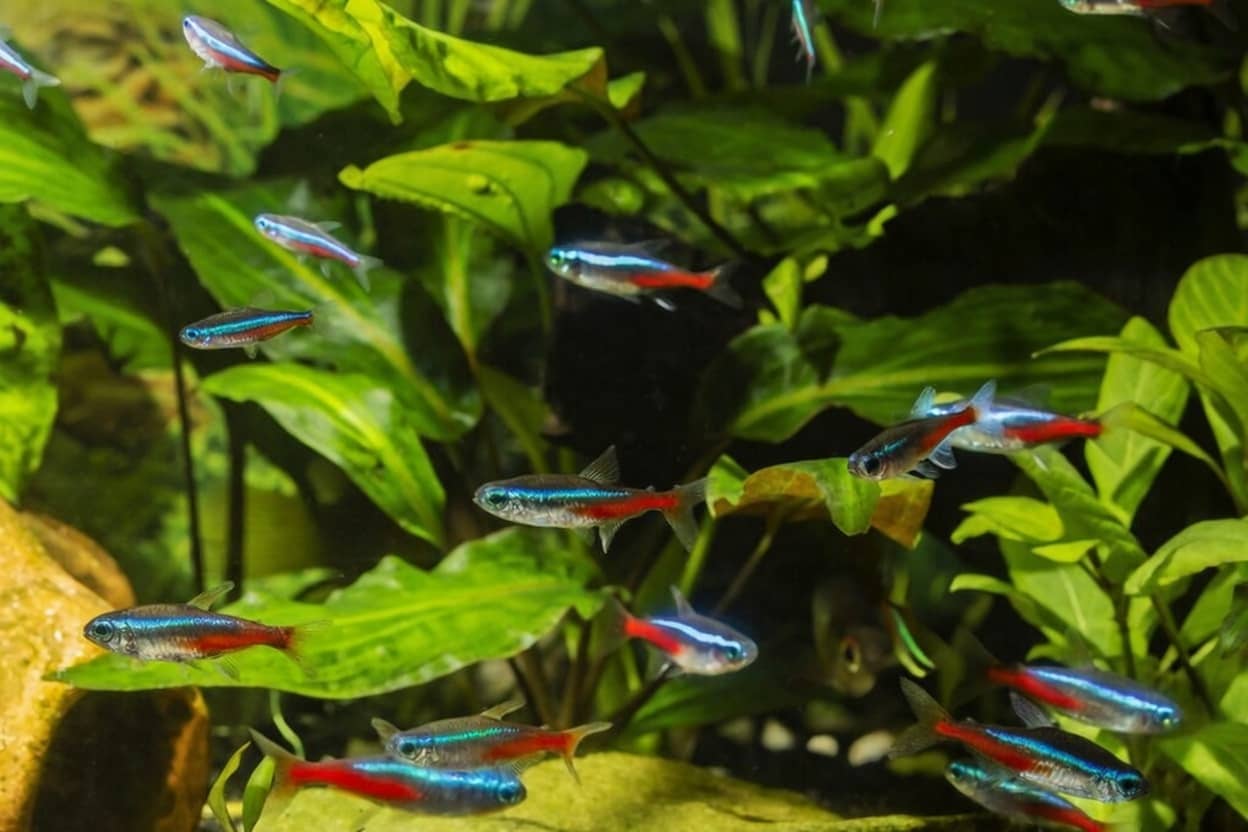
Tetras are the backbone of community fishkeeping. Walk into any aquarium store and you will see tank after tank stocked with these small, colorful schooling fish darting through the water in tight formations. Their peaceful temperament, manageable size, and dazzling variety make them the default choice for community aquariums of all sizes.
But not all tetras belong in a community tank. Some species are persistent fin nippers that stress out slower tank mates and damage fins. Choosing the wrong tetra can turn a peaceful aquarium into a stressful one.
This guide covers the 10 best tetras for community tanks — from tiny nano specialists that thrive in 10-gallon setups to large show tetras that need 30 gallons or more. Each species profile includes key care stats, temperament notes, and compatibility advice to help you pick the right tetras for your aquarium.
What Makes a Good Community Tetra?
Not every tetra sold at your local fish store is community-safe. The best community tetras share a specific set of traits that allow them to coexist peacefully with other species.
Traits of a Community-Safe Tetra
- Peaceful temperament — no fin nipping, scale eating, or territorial aggression toward other species
- Appropriate adult size — most community tetras range from 1 to 3 inches, large enough to avoid being eaten but small enough not to bully tank mates
- Compatible water parameters — the tetra should thrive in the same temperature, pH, and hardness range as other species in the tank
- Strong schooling instinct — tetras that school tightly feel secure and are far less likely to exhibit problem behaviors like nipping
- Adaptable diet — community tetras should accept standard flake, pellet, and frozen foods without specialized feeding requirements
The School Size Rule
Every tetra on this list needs a minimum school of 6 of the same species. Smaller groups lead to stress, faded colors, hiding, and fin nipping directed at other tank mates. When in doubt, go bigger — schools of 10 or more consistently produce the best behavior and most vibrant coloration.
The 10 Best Tetras for Community Tanks
Every tetra on this list is a solid pick — the numbering is just for easy reference, not a ranking. Any of these species will do well in a peaceful community setup.
1. Neon Tetra
Neon tetras are the most popular community tetra in the world, and they have held that title for decades. Their iridescent blue stripe and vivid red belly create a stunning display that never gets old, especially in a planted tank with dark substrate.
Neon Tetra
Paracheirodon innesi
| Parameter | Value |
|---|---|
| Adult Size | 1.5 inches |
| Temperament | Peaceful |
| Min School Size | 6 (10+ ideal) |
| Min Tank Size | 10 gallons |
| Temperature | 70-81°F |
Neon tetras are hardy, inexpensive, and available at virtually every fish store. Decades of captive breeding have made them adaptable to a wide range of water conditions, which is why they are recommended so often for beginners. Their small size and peaceful nature mean they pair well with almost every other common community species. Keep the tank well-maintained, as neon tetras can be susceptible to neon tetra disease in poor water quality.
2. Cardinal Tetra
Cardinal tetras are widely considered the more beautiful cousin of the neon tetra. The key visual difference is the red stripe — on a cardinal, it extends the full length of the body from eye to tail, while a neon tetra only shows red on the back half. For a detailed breakdown, see our cardinal tetra vs neon tetra comparison.
Cardinal Tetra
Paracheirodon axelrodi
| Parameter | Value |
|---|---|
| Adult Size | 2 inches |
| Temperament | Peaceful |
| Min School Size | 6 (10+ ideal) |
| Min Tank Size | 20 gallons |
| Temperature | 73-84°F |
Most cardinal tetras in the trade are wild-caught from the Rio Negro basin in South America. This means they tend to be hardier than mass-bred neons once properly acclimated, but they require softer, more acidic water to truly thrive. Cardinal tetras are an excellent choice for tanks with German blue rams or discus, as they share a preference for warm, soft water. Drip acclimation over 1 to 2 hours is recommended when bringing wild-caught cardinals home.
3. Ember Tetra
Ember tetras are the top choice for nano community tanks. At just 0.8 inches fully grown, these tiny fish pack an outsized visual punch — their deep orange-red coloration seems to glow against green plants, earning them a devoted following among planted tank enthusiasts.
Ember Tetra
Hyphessobrycon amandae
| Parameter | Value |
|---|---|
| Adult Size | 0.8 inches |
| Temperament | Peaceful |
| Min School Size | 8 (12+ ideal) |
| Min Tank Size | 10 gallons |
| Temperature | 73-84°F |
Ember tetras are one of the safest tetra species for shrimp tanks. Their mouths are too small to eat adult cherry shrimp, making them a go-to pairing for aquarists who want both schooling fish and a thriving shrimp colony. Because of their tiny size, avoid housing them with any fish large enough to see them as food. Schools of 12 to 20 embers in a 10-gallon planted tank create one of the most visually striking nano setups in the hobby.
4. Rummy-Nose Tetra
If you want the tightest schooling behavior of any commonly available tetra, the rummy-nose tetra is your fish. They move in synchronized formation like a single organism — changing direction together in a way that no other tetra species can match.
Rummy-Nose Tetra
Hemigrammus rhodostomus
| Parameter | Value |
|---|---|
| Adult Size | 2 inches |
| Temperament | Peaceful |
| Min School Size | 6 (10+ ideal) |
| Min Tank Size | 20 gallons |
| Temperature | 75-81°F |
Rummy nose tetras serve as a living water quality indicator. Their bright red nose fades rapidly when water parameters deteriorate — giving you an early visual warning before test kits might even register a problem. This makes them particularly useful in planted tanks where subtle parameter shifts are common. They are slightly more sensitive than neon tetras and do best in mature, well-established aquariums with stable water. Not the best beginner tetra, but outstanding for intermediate fishkeepers who maintain consistent conditions.
5. Black Neon Tetra
The black neon tetra is one of the most underrated community tetras available. Aquarium hobbyists who have kept them consistently rank them among the hardiest, most trouble-free tetras in the hobby — practically bulletproof once established.
Black Neon Tetra
Hyphessobrycon herbertaxelrodi
| Parameter | Value |
|---|---|
| Adult Size | 1.5 inches |
| Temperament | Peaceful |
| Min School Size | 6 (8+ ideal) |
| Min Tank Size | 10 gallons |
| Temperature | 73-81°F |
Despite the name, black neon tetras are not closely related to neon tetras. They have a distinctive red eye with a pair of white and black horizontal stripes running along the body. What makes them stand out is their resilience — they tolerate a wide range of water conditions and rarely succumb to the diseases that plague other tetra species. They are also inexpensive, so you can buy a large school without breaking the budget. A group of 12 or more black neons against a backdrop of green plants is genuinely striking.
6. Glowlight Tetra
The glowlight tetra earns its name from the luminous orange-red stripe that runs from nose to tail, appearing to glow from within under aquarium lighting. This species has been a staple of the hobby since the 1930s and remains popular for good reason.
Glowlight Tetra
Hemigrammus erythrozonus
| Parameter | Value |
|---|---|
| Adult Size | 1.5 inches |
| Temperament | Peaceful |
| Min School Size | 6 (10+ ideal) |
| Min Tank Size | 10 gallons |
| Temperature | 74-82°F |
Glowlight tetras thrive in dimly lit planted tanks, where their signature stripe stands out most dramatically against dark substrate and dense vegetation. They are beginner-friendly, accepting a wide range of water parameters and eating standard flake and pellet foods. Their translucent body creates a subtle, elegant look that differs from the bolder coloration of neons and cardinals. Glowlights pair particularly well with corydoras catfish and other small, peaceful bottom dwellers.
7. Lemon Tetra
The lemon tetra is one of the most underappreciated tetras in the hobby. At first glance, juveniles look washed out and unremarkable in a store tank. But give them time in a well-maintained planted aquarium, and mature lemon tetras develop a vibrant translucent yellow body with striking black-and-yellow fin markings and a brilliant ruby-red eye.
Lemon Tetra
Hyphessobrycon pulchripinnis
| Parameter | Value |
|---|---|
| Adult Size | 1.5-2 inches |
| Temperament | Peaceful |
| Min School Size | 6 (8+ ideal) |
| Min Tank Size | 15 gallons |
| Temperature | 72-82°F |
Lemon tetras are exceptionally hardy and tolerant of a broad range of water conditions, making them forgiving for beginners. Their warm yellow tones complement the blues and reds of other tetra species, creating a natural color contrast when multiple schools share the same tank. They are active swimmers that occupy the middle water column and show their best coloration under moderate lighting with dark substrate. With a lifespan of 6 to 8 years, lemon tetras are among the longest-lived tetras available.
8. Green Neon Tetra
The green neon tetra is the nano specialist of the Paracheirodon genus. At just 1 inch fully grown, it is the smallest of the three neon-type tetras and one of the best tetras for small tanks.
Green Neon Tetra
Paracheirodon simulans
| Parameter | Value |
|---|---|
| Adult Size | 1 inch |
| Temperament | Peaceful |
| Min School Size | 8 (12+ ideal) |
| Min Tank Size | 10 gallons |
| Temperature | 74-82°F |
Green neon tetras display a more prominent blue-green iridescent stripe that extends further toward the head than on standard neons, with minimal red coloration restricted to near the tail. They look best in blackwater setups with tannin-stained water, driftwood, and Indian almond leaves. Like ember tetras, their tiny size makes them safe with adult cherry shrimp. Green neons prefer soft, acidic water and school more impressively in larger groups — aim for 12 or more to see them at their best.
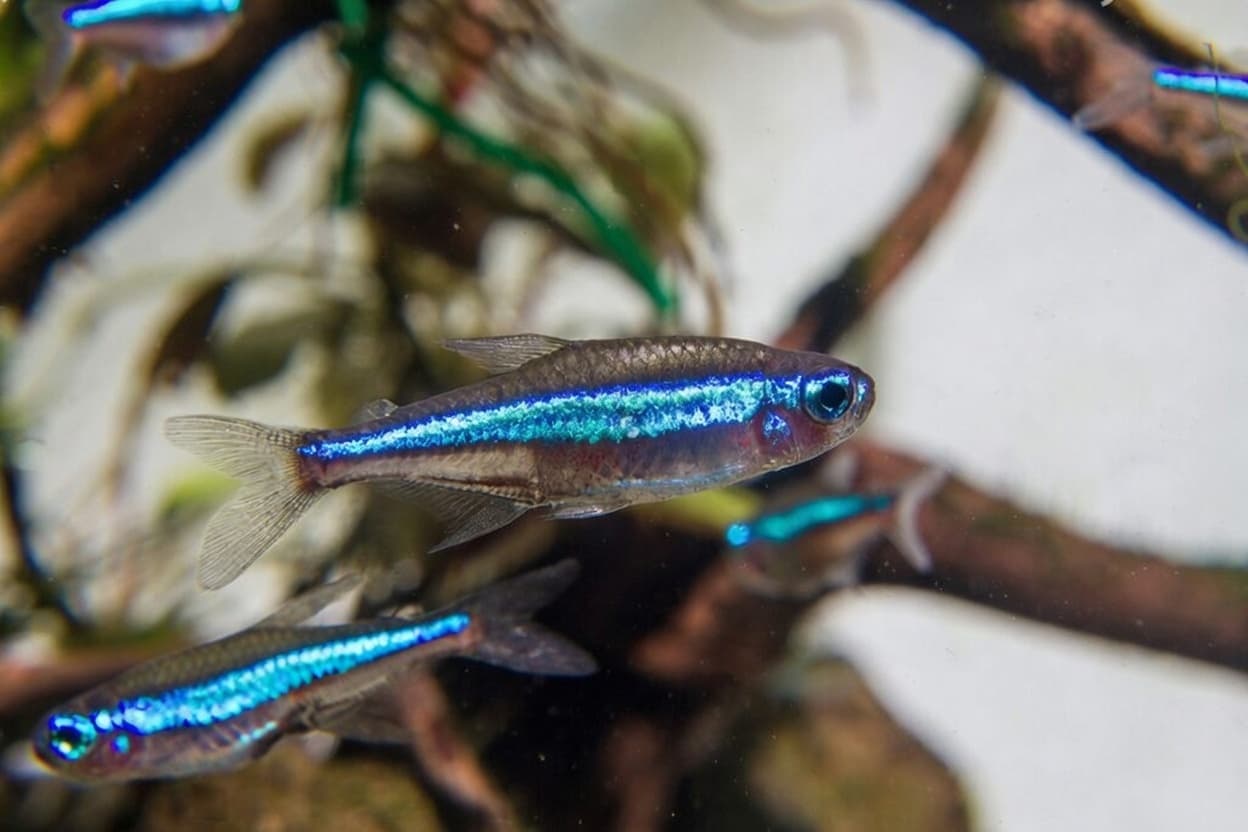
Green neon tetras show a more prominent blue-green stripe than standard neons — they look their best in blackwater setups with large schools.
Neon vs Cardinal vs Green Neon
The three Paracheirodon species each fill a different niche. Neon tetras are the most adaptable and beginner-friendly. Cardinal tetras offer the boldest color and prefer warmer, softer water. Green neon tetras are the smallest and best suited for nano tanks and blackwater setups. For a full comparison, see our cardinal tetra vs neon tetra guide.
9. Congo Tetra
The Congo tetra is the show tetra of the hobby — a large, iridescent species that transforms a bigger aquarium into something truly spectacular. Males develop flowing fin extensions and shimmer in shifting shades of blue, gold, orange, and green as they move through the water.
Congo Tetra
Phenacogrammus interruptus
| Parameter | Value |
|---|---|
| Adult Size | 3-3.5 inches |
| Temperament | Peaceful |
| Min School Size | 6 (8+ ideal) |
| Min Tank Size | 30 gallons |
| Temperature | 75-82°F |
Congo tetras originate from the Congo River Basin in Africa, making them one of the few popular aquarium tetras that are not South American. Their larger size means they need a 30-gallon tank at minimum, and they are best displayed in a 40-gallon or larger planted aquarium. Despite their size, they are peaceful and can coexist with smaller tetras, corydoras catfish, and dwarf cichlids like German blue rams. Avoid housing them with fin nippers, as their long, flowing fins make them a target.
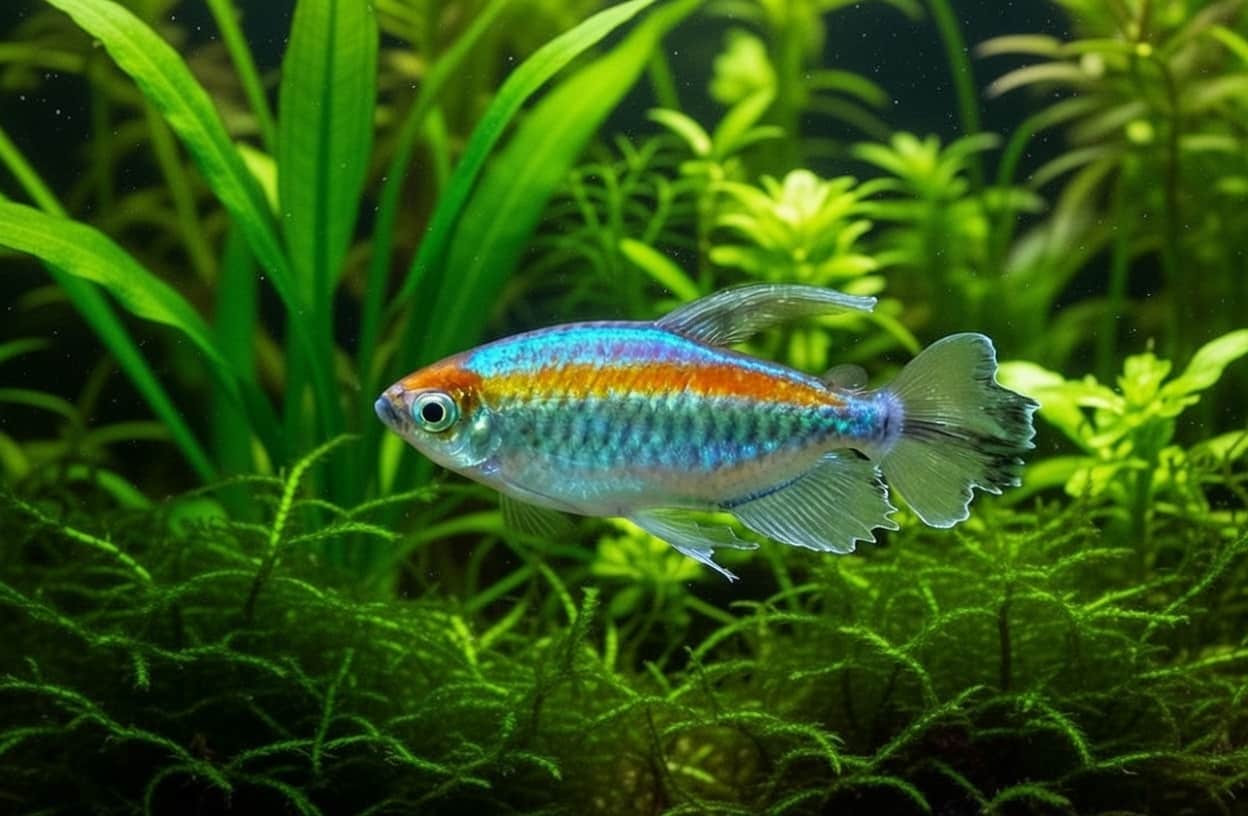
Male Congo tetras shimmer in shifting shades of blue, gold, and orange — one of the most visually impressive freshwater fish available.
Congo Tetras Need Space
Congo tetras are active swimmers that grow to over 3 inches. They will not do well in tanks under 30 gallons. Cramped conditions lead to stress, stunted growth, and washed-out coloration. If you have the tank size, a school of 8 Congo tetras is one of the most visually impressive displays in the freshwater hobby.
10. Diamond Tetra
The diamond tetra rounds out this list as one of the most stunning tetras that few people talk about. Their scales reflect light with a diamond-like sparkle that intensifies dramatically in mature fish kept in planted tanks with dark substrate.
Diamond Tetra
Moenkhausia pittieri
| Parameter | Value |
|---|---|
| Adult Size | 2-2.5 inches |
| Temperament | Peaceful (mostly) |
| Min School Size | 6 (8+ ideal) |
| Min Tank Size | 20 gallons |
| Temperature | 75-82°F |
Diamond tetras are native to Lake Valencia in Venezuela. They are hardy and adaptable, tolerating a reasonable range of water conditions. One caveat: diamond tetras can occasionally nip at the fins of very slow-moving or long-finned tank mates. Keeping them in a group of 8 or more largely eliminates this behavior, as they focus their social interactions within the school. Their iridescent scales, purple-tinted fins, and prominent red eye-spot create a fish that genuinely looks better in person than in photographs.
Tetras to Avoid in Community Tanks
Not every tetra belongs in a peaceful community aquarium. Several commonly sold species are fin nippers, aggressive chasers, or outright predators that will terrorize tank mates.
Keep These OUT of Community Tanks
- Serpae tetras (Hyphessobrycon eques) — notorious fin nippers that relentlessly target slow-moving and long-finned tank mates, even in large groups
- Buenos Aires tetras (Hyphessobrycon anisitsi) — aggressive fin nippers that also destroy live plants, eating them down to bare stems
- Black skirt tetras (Gymnocorymbus ternetzi) — can be nippy toward long-finned species like bettas, angelfish, and fancy guppies, especially in small groups
- Bucktooth tetras (Exodon paradoxus) — predatory scale-eaters that swarm and strip scales from any tank mate, regardless of size. Species-only tank required.
Serpae Tetras Are Not Community Safe
Serpae tetras are frequently sold as community fish due to their attractive deep red coloration, but they are one of the worst fin nippers in the hobby. Even in large groups, they direct aggression outward toward other species. If you want a red tetra for your community tank, choose ember tetras or cardinal tetras instead.
Tetra Schooling Rules
Understanding how tetras school — and what happens when they cannot — is essential for building a healthy community tank.
Minimum Numbers Matter
Every tetra species on this list is an obligate schooling fish. In the wild, schooling provides protection from predators. A tight-moving group confuses predators and makes it harder to single out one individual. This instinct is hardwired. Even in a predator-free aquarium, tetras that cannot school experience chronic stress that leads to:
- Faded, washed-out coloration
- Constant hiding behind plants or decorations
- Fin nipping directed at other species as a stress response
- Weakened immune system leading to disease susceptibility
- Shortened lifespan
Can You Mix Tetra Species?
Yes — but each species needs its own school. A tank with 3 neon tetras, 3 embers, and 3 rummy-noses is generally less ideal than a proper school of 9 neon tetras. Different tetra species do not school together. Each group forms its own cluster and needs at least 6 of its own kind to feel secure.
The upside of mixing species is visual variety. A 30-gallon tank with 10 neon tetras, 8 ember tetras, and 6 corydoras creates a layered display with different colors at different levels of the water column. Just make sure you have enough tank space for proper schools of each species.
Schooling Best Practices
- Minimum 6 of the same species — 10+ is better for most tetras
- Prioritize fewer species in larger schools over many species in small groups
- Nano tetras like embers and green neons benefit from even larger schools of 12+
- Add the full school at once rather than one or two fish at a time
- Watch for fin nipping — it is almost always a sign the school is too small
Best Tank Mates for Tetras
Tetras occupy the middle water column. The best community tanks pair them with species that fill different zones, creating a balanced display across the entire aquarium.
Bottom Dwellers
Corydoras catfish are the gold standard pairing for tetras. They are peaceful, social, and stay at the substrate level where tetras rarely go. Keep corydoras in groups of 6 or more on sand substrate. Kuhli loaches are another excellent option for the bottom zone — their nocturnal activity fills the tank with movement even after the lights dim.
Centerpiece Fish
Honey gouramis are the safest centerpiece for a tetra community tank. They are peaceful, colorful, and occupy the upper-middle zone without bothering schooling fish. For larger tanks of 30 gallons and up, German blue rams add stunning color and personality as bottom-to-mid-level centerpieces. Both species coexist peacefully with every tetra on this list.
Invertebrates
Cherry shrimp and amano shrimp make excellent additions to tetra community tanks. Amano shrimp are too large for any tetra to eat and provide exceptional algae control. Cherry shrimp are safe with smaller tetras like embers and green neons, but denser planting is recommended when housing them with larger species like rummy-nose or Congo tetras.
Other Schooling Fish
Harlequin rasboras and cherry barbs are not tetras, but they fill the same mid-water schooling role and pair naturally with any tetra species. Otocinclus catfish are another outstanding tank mate — these tiny algae eaters are completely peaceful and add bottom-level activity without competing for food or space.
Top Tank Mate Combinations
- Neon tetras + corydoras catfish + honey gourami — the classic 20-gallon community
- Ember tetras + cherry shrimp + otocinclus — the perfect nano planted tank
- Rummy nose tetras + German blue rams + sterbai corydoras — a warm-water South American biotope
- Congo tetras + cherry barbs + bristlenose pleco — a larger community for 40+ gallon tanks
- Cardinal tetras + harlequin rasboras + kuhli loaches — mixed schoolers with layered activity across the tank
How to Choose the Right Tetra for Your Tank
With 10 excellent options, narrowing down your choice comes down to three factors: tank size, water parameters, and the visual effect you want to create.
For tanks 10-15 gallons: Ember tetras, green neon tetras, or standard neon tetras give you the best results in smaller volumes. Stick to one species in a generous school.
For tanks 20-29 gallons: You have the most flexibility here. Neon tetras, cardinal tetras, rummy-nose tetras, black neon tetras, glowlight tetras, lemon tetras, and diamond tetras all work. You can keep one large school or two smaller schools of different species.
For tanks 30+ gallons: Congo tetras become an option, and you can build multi-species setups with three or more tetra schools occupying different visual niches. A planted tank with Congo tetras, a school of rummy-noses, and a group of corydoras on the bottom is a display that draws attention.
For shrimp tanks: Ember tetras and green neon tetras are the safest choices. Their tiny mouths cannot eat adult cherry shrimp, making them a go-to pairing for aquarists who want both fish and a thriving shrimp colony.
Whichever species you choose, remember the fundamentals: keep them in proper schools, maintain stable water parameters, feed a varied diet, and house them with compatible tank mates. Do that, and your tetras will reward you with years of vibrant color and fascinating schooling behavior.
For more species-specific guidance, explore our neon tetra care guide, ember tetra care guide, and cardinal tetra vs neon tetra comparison.
Frequently Asked Questions
What is the best tetra for a community tank?
The neon tetra is the best all-around tetra for community tanks. It is peaceful, hardy, inexpensive, widely available, and compatible with nearly every other community species. Neon tetras stay small at 1.5 inches, thrive in groups of 6 or more, and work in tanks as small as 10 gallons. For richer color, cardinal tetras are an excellent alternative.
How many tetras should I keep together?
Keep a minimum of 6 tetras of the same species together. Tetras are schooling fish that rely on group numbers for security. Schools smaller than 6 lead to stress, faded color, hiding, and sometimes fin nipping. Groups of 10 or more produce the best schooling behavior and most vibrant coloration. Always prioritize a larger school of one species over small groups of multiple species.
Can I mix different tetra species in the same tank?
Yes, you can keep multiple tetra species in the same tank as long as each species has at least 6 of its own kind. Different tetra species generally do not school together — each group forms its own cluster. A 20-gallon tank can comfortably support two species of 6 to 8 each, while a 40-gallon tank has room for three or more tetra schools.
Are all tetras peaceful community fish?
No. While most popular tetras are peaceful, several species are known fin nippers or outright predators. Serpae tetras and Buenos Aires tetras are notorious fin nippers that harass slow-moving or long-finned tank mates. Black skirt tetras can also be nippy. The bucktooth tetra is a scale-eating predator that will attack any tank mate. Always research a specific tetra species before adding it to a community tank.
What is the best tetra for a 10-gallon tank?
Ember tetras and green neon tetras are the best tetras for a 10-gallon tank. Both species stay under 1 inch, have a tiny bioload, and display excellent color in small planted tanks. You can keep a school of 8 to 10 in a 10-gallon aquarium. Standard neon tetras also work in a 10-gallon, though a school of 6 is the practical limit at that tank size.
Do tetras get along with shrimp?
Most small tetras coexist well with adult cherry shrimp and amano shrimp. Ember tetras and green neon tetras are among the safest tetra species for shrimp tanks because their mouths are too small to eat adult shrimp. Larger tetras like Congo tetras may eat smaller shrimp. Baby shrimp are at risk with virtually all tetra species, so dense planting is essential for shrimplet survival.
Why are my tetras nipping fins?
Fin nipping in tetras usually results from an insufficient school size. When kept in groups smaller than 6, tetras redirect their natural social behavior toward other tank mates. Increasing the group to 8 or more of the same species typically resolves the problem. Some tetra species like serpae tetras and black skirt tetras are inherently nippy regardless of group size and should not be housed with slow-moving or long-finned fish.
What temperature do tetras need?
Most community tetras thrive between 74 and 80 degrees Fahrenheit. This range works for neon tetras, cardinal tetras, ember tetras, rummy-nose tetras, and most other popular species. Congo tetras prefer slightly warmer water around 75 to 82 degrees Fahrenheit. Always use a reliable aquarium heater and verify the temperature with a separate thermometer.
Found this helpful?
Share this guide with your fellow aquarium enthusiasts!

Written by
Jonathan Jenkins
I've been keeping fish for over 15 years — everything from planted freshwater tanks to saltwater reefs. I currently have a 30 gallon overstocked guppy breeding tank, 40 gallon planted self-cleaning aquarium, 200 gallon reef tank, and 55 gallon frag tank. I joined Fish Tank World to continue learning while sharing what I've learned along the way.