
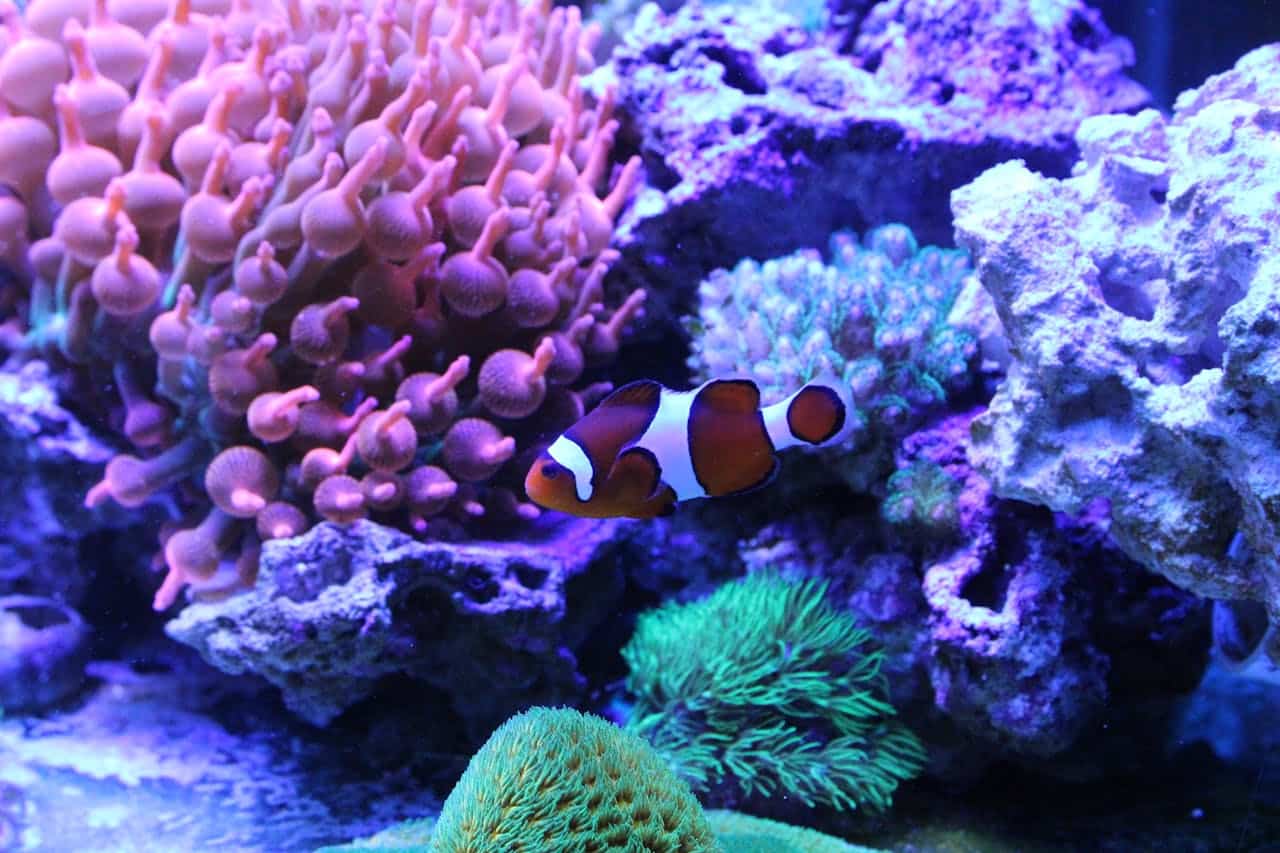
The best small saltwater fish for nano aquariums include the Ocellaris Clownfish, Royal Gramma Basslet, Fire Dartfish, Neon Goby, Yellow Watchman Goby, and Six-Line Wrasse — all reef-safe species that stay under 4 inches and thrive in tanks as small as 15 gallons. Not all tropical marine fish are suitable for nano aquariums, though. Juvenile fish often outgrow small tanks within months, territorial species create serious problems in confined spaces, and some fish aren’t compatible with corals or invertebrates. Nano tanks — generally defined as 15 gallons or under, though some hobbyists stretch the definition to 25 gallons — demand careful species selection. These 16 small saltwater fish stay compact, adapt well to smaller water volumes, and bring vibrant color to nano reef setups.
Nano Tank Stocking Rules
Overcrowding is the fastest way to crash a nano saltwater tank. Most species on this list do best as the only individual of their kind in a nano setup — avoid duplicating territorial species. Provide live rock caves and overhangs for hiding, maintain stable water parameters (harder in smaller volumes), and add fish slowly to let biological filtration adjust.
The 16 Best Small Saltwater Fish
1. Ocellaris Clownfish (Amphiprion ocellaris)
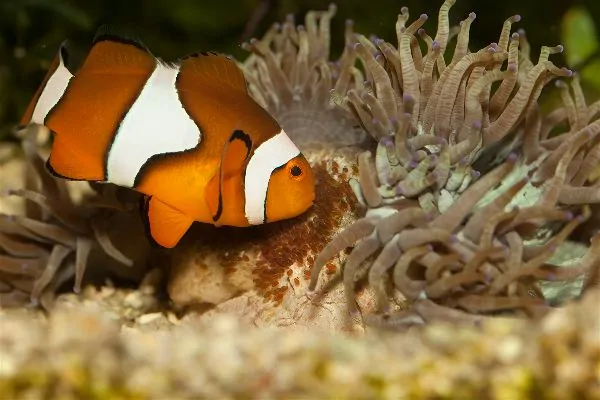
Ocellaris clownfish are widely captive-bred, making them hardy and well-adapted to aquarium life.
The Ocellaris Clownfish reaches approximately 3 inches and thrives in tanks as small as 15 gallons. Captive-bred Ocellaris Clownfish are widely available, making them hardier and better adapted to aquarium conditions than wild-caught specimens. Ocellaris Clownfish accept both meaty and herbivore foods readily.
| Parameter | Requirement |
|---|---|
| Adult Size | ~3 inches |
| Min Tank | 15 gallons |
| Diet | Omnivore (meaty + herbivore foods) |
| Reef Safe | Yes |
Care Tips: Keep a single Ocellaris Clownfish or a mated pair — never two unpaired individuals, as they will fight. The Ocellaris Clownfish is suitable for a single-fish nano setup and pairs well with most peaceful reef inhabitants. An anemone host is appreciated but not required.
2. Blue Chromis (Chromis cyaneus)
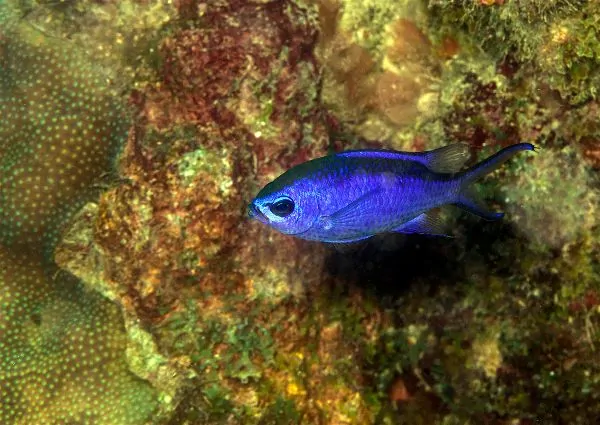
Blue Chromis are peaceful schooling fish that add movement and color to the upper water column.
Blue Chromis are peaceful schooling fish that can reach up to 5 inches at maturity, though they typically stay smaller in nano tanks. A group of three Blue Chromis fits comfortably in a 15-gallon tank, while smaller nano setups should limit stocking to a single specimen. Blue Chromis accept both meaty foods and herbivore preparations.
| Parameter | Requirement |
|---|---|
| Adult Size | Up to 5 inches |
| Min Tank | 15 gallons (for 3) |
| Diet | Omnivore (meaty + herbivore foods) |
| Reef Safe | Yes |
Care Tips: Blue Chromis are among the easiest saltwater fish to keep. Their brilliant blue coloration and active swimming behavior add movement to reef displays. Blue Chromis stay toward the upper water column, leaving bottom territory for gobies and other substrate-dwelling species.
3. Royal Gramma Basslet (Gramma loreto)
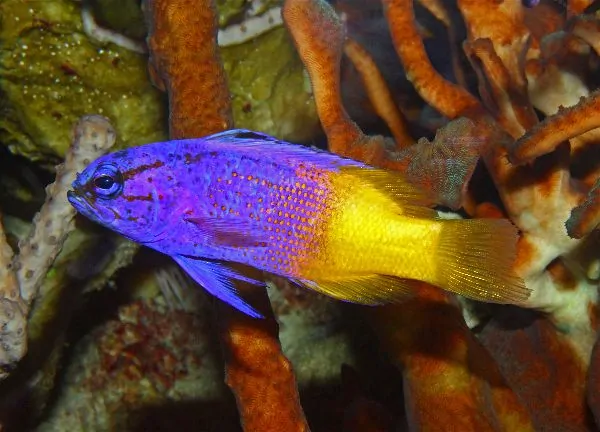
Royal Gramma Basslets are Caribbean reef fish that need live rock caves for security.
The Royal Gramma Basslet is a Caribbean reef species reaching approximately 3 inches with stunning purple and yellow coloration. Royal Gramma Basslets are carnivores that thrive on frozen and prepared meat-based foods. Royal Gramma Basslets need live rock caves and overhangs to feel secure.
| Parameter | Requirement |
|---|---|
| Adult Size | ~3 inches |
| Origin | Caribbean |
| Diet | Carnivore (frozen/prepared meaty foods) |
| Reef Safe | Yes |
Care Tips: Keep only one Royal Gramma Basslet per tank — they are aggressive toward other basslets. In small nano tanks, avoid pairing Royal Gramma Basslets with chromis or dartfish, as territorial disputes become more likely in confined spaces. Provide multiple cave openings in the live rock for the Royal Gramma Basslet to claim as territory.
4. Fire Dartfish (Nemateleotris spp.)
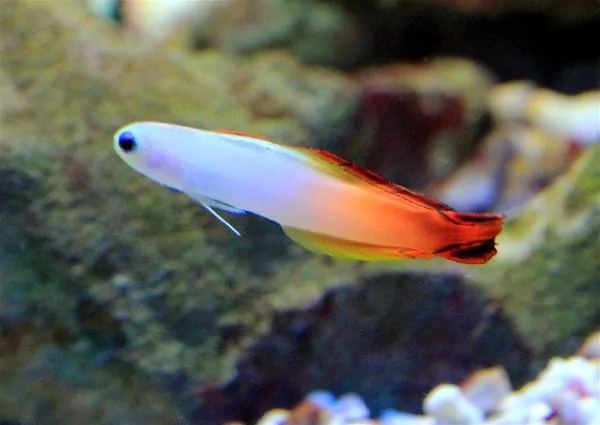
Fire Dartfish hover elegantly above the reef — their elongated dorsal fin is their most distinctive feature.
The Fire Dartfish (also called Firefish Goby) reaches approximately 3 inches and is completely reef compatible. Fire Dartfish are carnivores that benefit from vitamin-enriched brine shrimp and mysis shrimp. Their elongated dorsal fin and red-orange gradient coloration make Fire Dartfish standout additions to peaceful nano reef tanks.
| Parameter | Requirement |
|---|---|
| Adult Size | ~3 inches |
| Diet | Carnivore (vitamin-enriched brine/mysis shrimp) |
| Reef Safe | Yes |
Care Tips: Fire Dartfish need rocky caves for retreating when startled. Fire Dartfish are compatible with most nano fish, but use caution housing Fire Dartfish with basslets or chromis in tanks under 20 gallons. Fire Dartfish are jumpers — a tight-fitting lid is recommended.
5. Pajama Cardinalfish (Sphaeramia nematoptera)
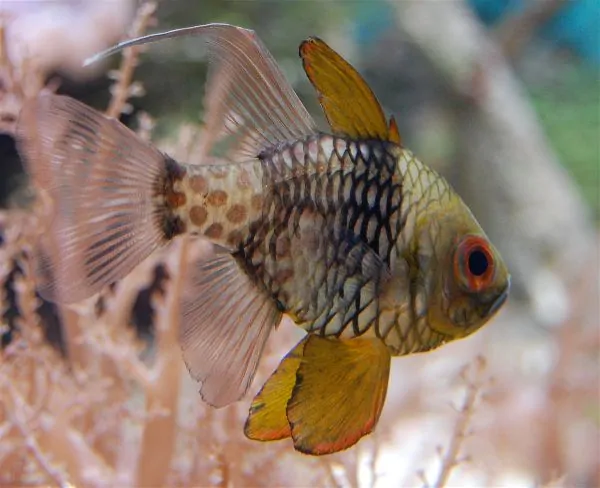
Pajama Cardinalfish are slow swimmers that prefer dim lighting and calm tankmates.
Pajama Cardinalfish reach 3-4 inches and feature one of the most distinctive patterns in the marine hobby — polka dots, bold color bands, and large eyes. A school of three Pajama Cardinalfish fits in a 15-gallon aquarium. Pajama Cardinalfish are peaceful with invertebrates, corals, and most other nano fish.
| Parameter | Requirement |
|---|---|
| Adult Size | 3-4 inches |
| Min Tank | 15 gallons (for 3) |
| Diet | Omnivore (shrimp, flakes, bloodworms, chopped fish) |
| Reef Safe | Yes |
Care Tips: Pajama Cardinalfish are slow swimmers that prefer dim lighting conditions. Avoid housing Pajama Cardinalfish with blennies, which may become aggressive toward them. Pajama Cardinalfish accept a wide variety of foods including frozen shrimp, flakes, bloodworms, and finely chopped fish.
6. Neon Goby (Elacatinus oceanops)
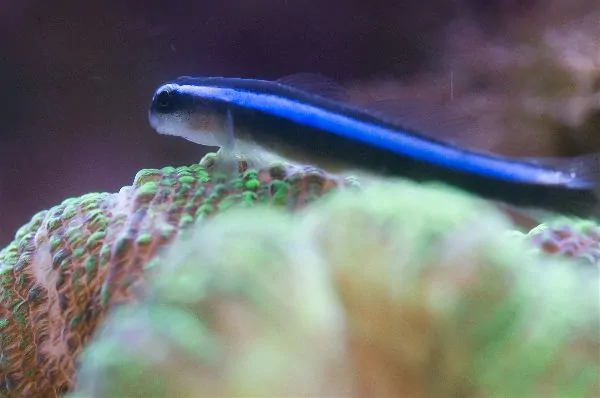
Neon Gobies are natural cleaner fish — they remove parasites from larger tankmates.
The Neon Goby reaches only 2 inches, making it an excellent choice for the smallest nano tanks. Neon Gobies are carnivores that accept live brine shrimp, mysis shrimp, and prepared foods. As natural cleaner fish, Neon Gobies provide the bonus of removing parasites from larger tankmates.
| Parameter | Requirement |
|---|---|
| Adult Size | ~2 inches |
| Diet | Carnivore (live brine/mysis shrimp, prepared foods) |
| Reef Safe | Yes |
Care Tips: Keep only one Neon Goby per nano tank unless you have a mated pair. Unpaired Neon Gobies will fight in confined spaces. Neon Gobies dart around live rock throughout the day and are active, engaging fish to watch.
7. Pink Skunk Clownfish (Amphiprion perideraion)
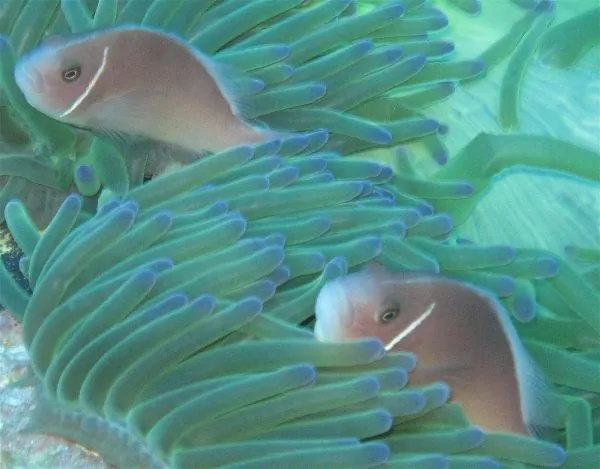
Pink Skunk Clownfish are less common than Ocellaris but offer similar hardiness with unique coloration.
The Pink Skunk Clownfish grows up to 4 inches and works well as the dominant fish in a nano setup. Pink Skunk Clownfish are semi-aggressive and accept both meaty foods and herbivore flake or pellet preparations. Captive-bred Pink Skunk Clownfish are preferred over wild-caught specimens for better aquarium adaptability.
| Parameter | Requirement |
|---|---|
| Adult Size | Up to 4 inches |
| Diet | Omnivore (meaty foods + herbivore flake/pellet) |
| Reef Safe | Yes (especially with anemone partner) |
Care Tips: Keep only one Pink Skunk Clownfish per small nano tank due to their semi-aggressive temperament. Pink Skunk Clownfish pair naturally with host anemones, though an anemone is not strictly required. Less commonly available than Ocellaris Clownfish, the Pink Skunk Clownfish offers unique pastel coloration.
8. Six-Line Wrasse (Pseudocheilinus hexataenia)
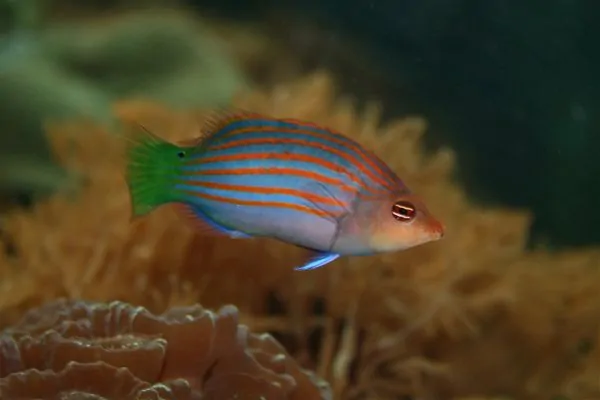
Six-Line Wrasses earn their keep by hunting pest flatworms and bristle worms in reef tanks.
The Six-Line Wrasse reaches approximately 3 inches and is a valuable addition to reef tanks as a natural pest controller. Six-Line Wrasses are carnivores that eat meaty foods, shrimp, flakes, and pellets — plus they actively hunt bristle worms, flatworms, and pyramidellid snails that plague reef aquariums.
| Parameter | Requirement |
|---|---|
| Adult Size | ~3 inches |
| Diet | Carnivore (meaty foods, shrimp, flake/pellets) |
| Reef Safe | Yes (won’t peck corals or bully shrimp) |
Care Tips: Provide plenty of hiding places to keep the Six-Line Wrasse peaceful toward tankmates. Six-Line Wrasses are active swimmers with striking purple and orange stripes. Their pest-control behavior makes the Six-Line Wrasse especially valuable in reef tanks dealing with flatworm or bristle worm infestations.
9. Chalk Bass (Serranus tortugarum)
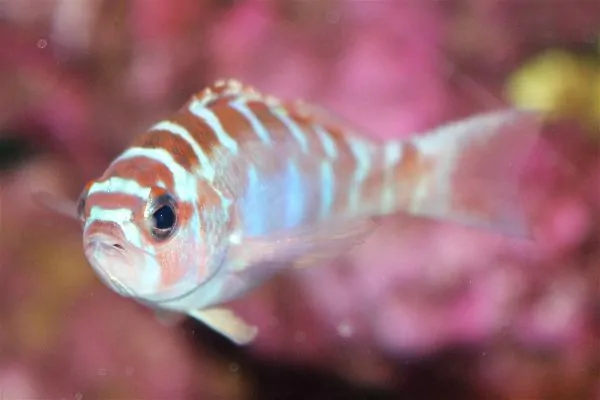
Chalk Bass are peaceful Caribbean species — add multiples simultaneously to prevent territorial aggression.
The Chalk Bass is a Caribbean species reaching 3 inches with attractive orange and blue vertical stripe coloration. Chalk Bass are carnivores that accept mysis shrimp, brine shrimp, and small pellets. Chalk Bass are reef-compatible and peaceful in most community setups.
| Parameter | Requirement |
|---|---|
| Adult Size | ~3 inches |
| Origin | Caribbean |
| Diet | Carnivore (mysis shrimp, brine shrimp, small pellets) |
| Reef Safe | Yes (mature fish may occasionally peck shrimp) |
Care Tips: If keeping multiple Chalk Bass, add all individuals simultaneously to prevent territorial disputes. Chalk Bass prefer tanks with plenty of rockwork for darting in and out. Note that mature Chalk Bass may occasionally bother very small ornamental shrimp.
10. Yellow Watchman Goby (Cryptocentrus cinctus)
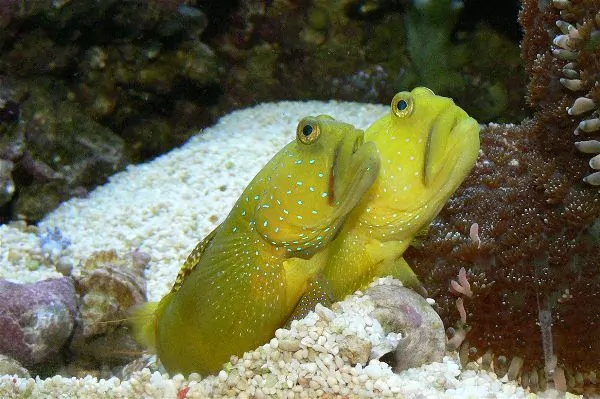
Yellow Watchman Gobies are burrowers that often form symbiotic partnerships with pistol shrimp.
The Yellow Watchman Goby grows up to 4 inches and is known for its burrowing behavior and bright yellow body with blue spots on the head and fins. Yellow Watchman Gobies are carnivores that accept brine shrimp, mysid shrimp, and prepared foods. Yellow Watchman Gobies frequently form symbiotic partnerships with pistol shrimp in reef aquariums.
| Parameter | Requirement |
|---|---|
| Adult Size | Up to 4 inches |
| Diet | Carnivore (brine shrimp, mysid shrimp, prepared foods) |
| Reef Safe | Yes |
Jumper Alert
Yellow Watchman Gobies are known jumpers. A tight-fitting lid with no gaps is essential — even small openings can allow a Yellow Watchman Goby to escape the tank.
Care Tips: Yellow Watchman Gobies move sand and build hides under rockwork, so secure rock structures to prevent collapse. Keep only mated pairs together — unpaired Yellow Watchman Gobies will fight. The Yellow Watchman Goby perches on rocks watching for danger, making it one of the more engaging species to observe.
11. Flame Hawkfish (Neocirrhites armatus)
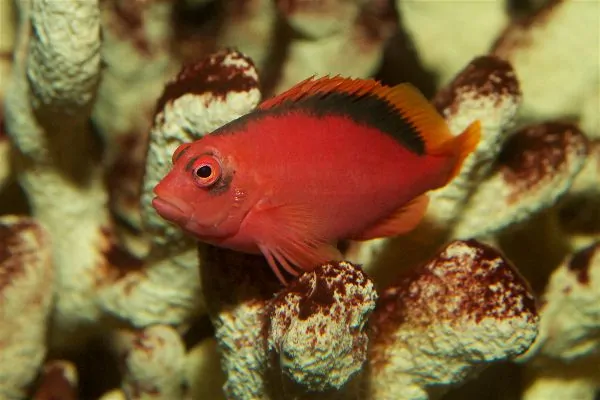
Flame Hawkfish perch on rock ledges and survey their territory — striking but predatory toward small shrimp.
The Flame Hawkfish reaches up to 4 inches and displays brilliant red coloration that makes it one of the most visually striking nano reef fish. Flame Hawkfish are carnivores originating from Fiji that eat live shrimp, marine meat, and prepared diets. Flame Hawkfish perch on rock ledges, surveying territory rather than swimming in open water.
| Parameter | Requirement |
|---|---|
| Adult Size | Up to 4 inches |
| Origin | Fiji |
| Diet | Carnivore (live shrimp, marine meat, prepared diets) |
| Reef Safe | Partial — will eat small shrimp |
Not Safe with Ornamental Shrimp
Flame Hawkfish will prey on ornamental shrimp including cleaner shrimp and decorative species. If your nano reef includes expensive shrimp, choose a different fish. Flame Hawkfish may also conflict with blennies and gobies over territory in small tanks.
Care Tips: Provide rock ledges for the Flame Hawkfish to perch on. Despite their small size, Flame Hawkfish are opportunistic predators — keep them away from blennies, gobies, and any shrimp small enough to eat. The Flame Hawkfish works best as the dominant predator in a nano setup stocked with faster-swimming upper-water species.
12. Hector’s Goby (Koumansetta hectori)
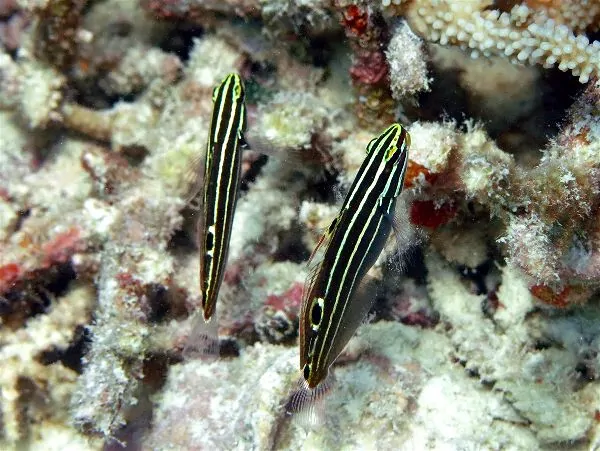
Hector's Gobies graze algae from rock surfaces, providing natural cleanup in nano reef tanks.
Hector’s Goby reaches approximately 3 inches and originates from Indonesia. Hector’s Goby features a dark body with horizontal yellow stripes and grazes algae from rock surfaces, providing natural cleanup duty. Hector’s Goby is an omnivore that benefits from a varied diet including vitamin-enriched foods.
| Parameter | Requirement |
|---|---|
| Adult Size | ~3 inches |
| Origin | Indonesia |
| Diet | Omnivore (varied + vitamin-enriched foods) |
| Reef Safe | Yes |
Care Tips: Keep only one Hector’s Goby per tank. Hector’s Goby is undemanding, accepting most prepared foods while also grazing beneficial algae from rockwork. Hector’s Goby adapts well to nano tank life and won’t bother corals, invertebrates, or most other small fish.
13. Dwarf Seahorse (Hippocampus zosterae)
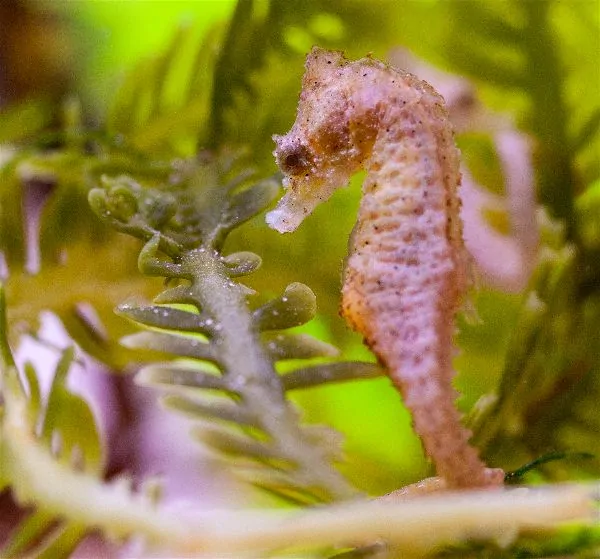
Dwarf Seahorses are fascinating but demanding — they require species-only tanks and live food.
The Dwarf Seahorse reaches only 2 inches, making it one of the smallest marine fish available. Dwarf Seahorses come in brown, white, or yellow, sometimes with black spots. Dwarf Seahorses require a dedicated seahorse-only aquarium — they cannot compete with other fish for food or territory.
| Parameter | Requirement |
|---|---|
| Adult Size | ~2 inches |
| Min Tank | 5 gallons (for 1-2) |
| Diet | Live hatched brine shrimp or live shrimp larvae only |
| Reef Safe | No — seahorse-only tank required |
Species-Only Tank Required
Dwarf Seahorses must be kept in a seahorse-only aquarium without strong currents or aggressive tankmates. They are weak swimmers that cannot compete for food. Use an air-powered sponge filter instead of powerheads, and provide vertical structures for Dwarf Seahorses to grip with their prehensile tails. Small hermit crabs and snails are the only compatible tankmates.
Care Tips: Dwarf Seahorses require multiple daily feedings of live hatched brine shrimp — they do not accept frozen or prepared foods. Keep water flow minimal. Provide plenty of vertical grip structures like macroalgae, gorgonians, or artificial holdfast decorations. A 5-gallon tank supports 1-2 Dwarf Seahorses.
14. Black Cap Basslet (Gramma melacara)
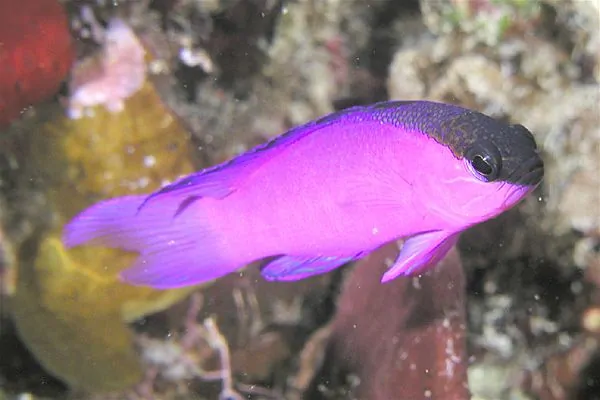
Black Cap Basslets are deep-water Caribbean reef fish — their purple and black coloration is striking under reef lighting.
The Black Cap Basslet grows up to 4 inches and originates from Caribbean deep-water reefs. Black Cap Basslets display a bright purple body with a distinctive black “cap” extending from the head along the dorsal fin. Black Cap Basslets are carnivores that actively forage for live shrimp in rockwork.
| Parameter | Requirement |
|---|---|
| Adult Size | Up to 4 inches |
| Origin | Caribbean (deep-water reef) |
| Diet | Carnivore (frozen fish, shrimp, live foods) |
| Reef Safe | Yes (compatible with corals and larger shrimp) |
Care Tips: Keep only one Black Cap Basslet per tank — like the Royal Gramma Basslet, this species is aggressive toward other basslets. Black Cap Basslets need adequate hiding spaces in the rockwork. The Black Cap Basslet is compatible with corals and larger ornamental shrimp but may catch very small shrimp.
15. Catalina Goby (Lythrypnus dalli)
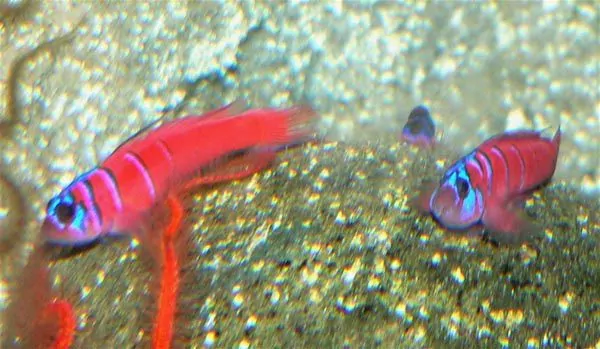
Catalina Gobies require cold water (60-70°F) — they cannot survive in standard tropical reef temperatures.
The Catalina Goby reaches only 2 inches and displays bold orange, red, and blue coloration that makes it one of the most visually striking gobies available. Catalina Gobies originate from the Eastern Pacific coast of the United States. Catalina Gobies are carnivores that accept fish, shrimp, and prepared carnivore flakes.
| Parameter | Requirement |
|---|---|
| Adult Size | ~2 inches |
| Origin | Eastern Pacific coast, USA |
| Diet | Carnivore (fish, shrimp, prepared carnivore flakes) |
| Temperature | 60-70°F (cold water only) |
| Reef Safe | Yes |
Cold Water Species — Not for Tropical Tanks
Catalina Gobies require water temperatures between 60-70°F — significantly cooler than the 76-82°F range of standard tropical reef aquariums. Keeping Catalina Gobies in tropical temperatures dramatically shortens their lifespan. Only add Catalina Gobies to specialized temperate marine setups with an aquarium chiller.
Care Tips: Multiple Catalina Gobies can coexist in tanks over 10 gallons, unlike most goby species on this list. The Catalina Goby’s stunning coloration makes the investment in a cold-water setup worthwhile for dedicated hobbyists, but this species is not recommended for standard heated reef tanks.
16. Sharknose Goby (Elacatinus evelynae)
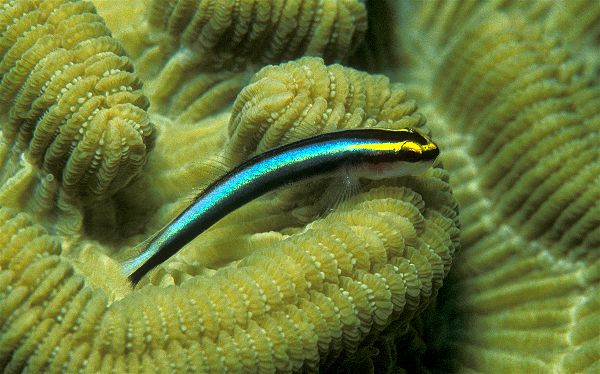
Sharknose Gobies are peaceful reef dwellers — captive-bred specimens adapt fastest to aquarium life.
The Sharknose Goby reaches up to 2 inches with distinctive blue and yellow coloration. Sharknose Gobies are carnivores that accept frozen and fresh meaty foods, brine shrimp, and carnivore flakes. Sharknose Gobies are peaceful toward other reef inhabitants but aggressive toward other Sharknose Gobies.
| Parameter | Requirement |
|---|---|
| Adult Size | Up to 2 inches |
| Diet | Carnivore (frozen/fresh meaty foods, brine shrimp, carnivore flakes) |
| Reef Safe | Yes |
Care Tips: Keep only one Sharknose Goby per tank — this species is aggressive toward its own kind. Captive-bred Sharknose Gobies are recommended over wild-caught, as they adapt faster to aquarium conditions and prepared foods. The Sharknose Goby is an excellent choice for the smallest nano setups due to its compact 2-inch adult size.
Compatibility Quick Reference
Not every combination of nano fish works in confined spaces. Use these guidelines when planning your stocking:
Species to Keep Alone (One Per Tank)
- Royal Gramma Basslet — aggressive toward other basslets
- Black Cap Basslet — fights with all other basslets
- Hector's Goby — territorial toward its own species
- Sharknose Goby — aggressive toward other Sharknose Gobies
- Neon Goby — only mated pairs together
Special Requirements
- Dwarf Seahorse — species-only tank, live food, minimal flow
- Catalina Goby — cold water only (60-70°F), not compatible with tropical setups
- Flame Hawkfish — will eat ornamental shrimp, territorial with bottom-dwellers
- Yellow Watchman Goby — tight-fitting lid required (jumper)
Stocking Best Practices for Nano Saltwater Tanks
Nano Reef Stocking Guidelines
- Research each species' adult size — not just juvenile size at the store
- Avoid keeping multiple fish of the same territorial species
- Provide live rock caves, overhangs, and hiding spots for every fish
- Maintain stable water parameters — smaller volumes swing faster
- Start with the hardiest species first (Ocellaris Clownfish, Blue Chromis)
- Add fish one at a time over weeks to let biological filtration adjust
- Use a tight-fitting lid — many nano species are jumpers
- Consider a protein skimmer even on nano tanks for better water quality
Maintaining excellent water quality is even more critical in nano saltwater tanks than in larger setups. Small water volumes amplify every mistake — a missed water change or overfeeding event impacts a 15-gallon tank far more dramatically than a 75-gallon system. If you’re setting up your first nano reef, consider an all-in-one saltwater aquarium kit that includes integrated filtration and appropriate lighting. For more on saltwater aquarium keeping, explore our guides on protein skimmers, live rock, and coral feeding.
What size tank do I need for small saltwater fish?
Most small saltwater fish require a minimum of 15 gallons, though 20-30 gallons provides more stable water parameters and stocking flexibility. Nano tanks under 10 gallons are limited to very few species like dwarf seahorses.
Can I keep multiple small saltwater fish together?
Yes, but carefully select compatible species. Avoid keeping multiple fish of the same species unless they're known to school (like chromis) or are a mated pair. Many small saltwater fish are territorial toward their own kind, especially basslets and gobies.
Are small saltwater fish reef-safe?
Most species on this list are reef-safe, meaning they won't harm corals or invertebrates. However, flame hawkfish will prey on small shrimp, and dwarf seahorses need species-only tanks. Always research specific species before adding to reef tanks.
What do small saltwater fish eat?
Most accept frozen foods like mysis shrimp, brine shrimp, and marine pellets. Carnivores benefit from vitamin-enriched frozen foods, while omnivores need both meaty and herbivore preparations. Dwarf seahorses are an exception, requiring live hatched brine shrimp.
How many fish can I keep in a nano saltwater tank?
A 15-gallon nano tank typically supports 2-3 small fish depending on species. A 20-gallon supports 3-4. Overcrowding in saltwater nano tanks causes rapid water quality decline, stress, disease, and aggression — always stock conservatively.
Found this helpful?
Share this guide with your fellow aquarium enthusiasts!
Written by
FTW Team
The FishTankWorld editorial team brings together experienced aquarists to help you succeed in the hobby.